
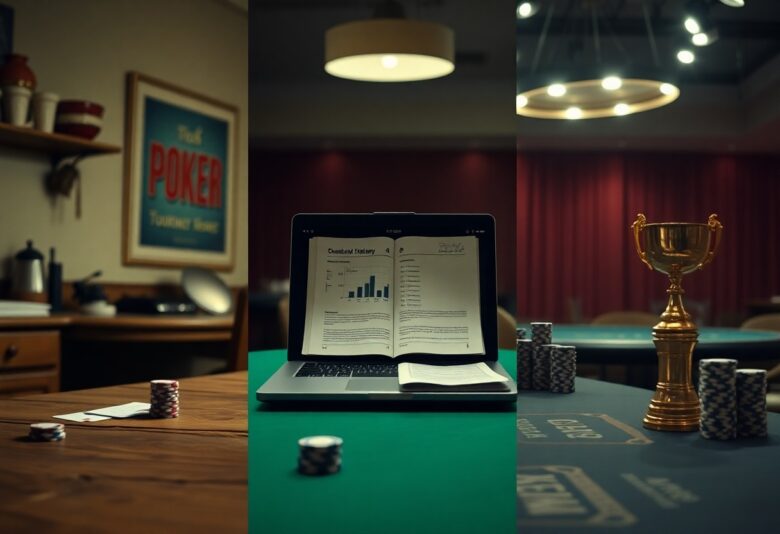
Amateur players intent on becoming professional must build a disciplined, study-driven approach that balances technical skill and emotional control: prioritize bankroll management, rigorous study and practice, smart table selection, and relentless review of hands. Respect the game’s harsh variance and guard against tilt, while developing long-term discipline and strategic adaptability to convert small edges into consistent profit.
Understanding Poker
Mastering poker requires deep work on hand equity, bet sizing and range construction: Hold’em has 169 starting-hand categories and 1,326 two-card combos to internalize, while variance means long losing stretches are normal-protect yourself with strict bankroll management (20-40 buy-ins for cash, larger for MTTs) and active anti-tilt routines to preserve decision quality.
Types of Poker Games
Variants force different math and habits: Texas Hold’em centers on position and range balance; Omaha rewards nut awareness with 4 hole cards; Seven-Card Stud demands memory of upcards; Razz inverts value toward lows; mixed games (HORSE) test cross-format skill. Thou specialize in one variant for at least 1,000 hands before branching out.
- Texas Hold’em
- Omaha
- Seven-Card Stud
- Razz
- Mixed (HORSE)
| Texas Hold’em | No-limit, emphasis on position, 169 starting-hand types |
| Omaha | Pot-limit common, four hole cards, nut-hunting dynamics |
| Seven-Card Stud | Fixed-limit typical, focus on exposed cards and memory |
| Razz | Lowball variant, different equity calculations and hand values |
| Mixed | Rotating formats; rewards versatility and game-selection skill |
Essential Rules and Strategies
Know the betting rounds (preflop, flop, turn, river), standard hand rankings and practical metrics: a flop flush draw completes ~35% by river, open-raise sizing typically 2.2-3x online and 3-4x live, and stack depth dictates strategy-play tighter under 40bb and expand ranges with 100+bb; enforce position discipline and strict bankroll rules to survive variance.
When refining strategy, quantify ranges and track frequencies: open from the button ~25-30% in a full-ring game, defend blinds with 30-40% vs late opens depending on opponent tendencies, and use a 3-bet range of ~6-12% from the CO/BTN versus looser opens. In tournaments apply ICM-aware adjustments-push/fold charts become optimal under ~10-12bb-and in cash games prioritize exploitative adjustments against common leaks like overcalling and predictable c-bet frequencies. Emphasize study methods: review 500+ hands weekly with software, analyze equity with solvers for specific lines, and practice deliberate game-selection to maximize edge while avoiding high-variance pitfalls such as emotional play and poor bankroll allocation.
Step-by-Step Guide to Improving Your Game
Step Overview
| Focus Area | Action |
| Study Plan | Schedule 4-6 hours/week: review hands, solver work, and theory modules. |
| Live/Table Practice | Apply concepts in 200-500 hands sessions, track results and leaks. |
| Bankroll | Maintain a buffer of ~20-50 buy-ins; adjust stakes after 2-3 months of positive ROI. |
| Mental Game | Use session journaling and tilt controls; log tilt triggers and recovery routines. |
Building Fundamental Skills
Develop tight hand selection and exploit positional leverage: early position requires narrower ranges while late position expands to steal blinds. Learn pot odds and equity-calculate whether calling a 3:1 pot with a draw is profitable. Track a sample of at least 20,000 hands to spot recurring leaks, and use note-taking to catalog opponent tendencies like showdown frequency and aggression rates.
Fundamentals Checklist
| Skill | How to Train |
| Position Play | Review hands from button vs. blinds; practice isolation raises. |
| Pot Odds & EV | Solve common scenarios with a calculator; memorize key ratios. |
| Bankroll Control | Set buy-in limits and session loss caps. |
Advanced Techniques for Experienced Players
Blend GTO concepts with exploitative adjustments: use solvers to learn balanced ranges, then deviate when opponents show systematic weaknesses. Study range construction, blocker effects, and multi-street planning; top regs analyze 100k+ hands and run solver drills on 3-4 common river spots to internalize mixed frequencies and river bet sizing patterns.
- Run solver drills on 3-bet pots and analyze bluff-to-value ratios.
- Use range vs. range simulations to practice line selection in 1,000-hand blocks.
- Track opponent-specific exploit metrics: fold-to-3bet, c-bet frequency, river calling range.
- Implement dynamic bet sizing with polarization on rivers when blockers favor bluffs.
Advanced Techniques Summary
| Technique | Application |
| Solver Integration | Run weekly solver spots, incorporate solver-approved bet sizes into practice. |
| Exploitative Adjustments | Adjust ranges versus players who overfold or overcall; widen value range accordingly. |
| Multi-Table & Live Balance | Translate online frequency data to live reads; adjust aggression and table selection. |
Dig deeper by meshing sample-based study with targeted drills: pick 5 recurring river scenarios from your database, solve them, then play 500 hands applying the solver-suggested mixed strategies while logging frequencies. Emphasize variance management-use session stop-loss rules and review sessions where ROI deviated by >15% to isolate skill vs. luck. Regularly test a single adjustment (e.g., increasing 3-bet range by 2-4%) for statistical impact over 10k hands.
- Identify 5 high-frequency river spots from your hand history.
- Run solver for each spot and extract 3-4 practical bet sizes.
- Implement one adjustment per month and measure EV change over 10k hands.
- Maintain tilt-control protocols and a session ledger for accountability.
Advanced Drill Plan
| Drill | Duration/Goal |
| Solver Spot Practice | Weekly, 2 hours; internalize mixed strategies for chosen spots. |
| Database Analysis | Monthly, 4 hours; extract 10 opponent profiles and exploit paths. |
| Live Replication | Bi-weekly, 1-2 sessions; apply solver lines in real money play. |
Factors Influencing Success in Poker
Edge comes from multiple areas; weigh these core factors:
- bankroll management – 20-40 buy-ins for cash, 100+ for MTTs
- variance – long swings can erase months of profit
- table selection – finding softer games can add +5-20 BB/100
- mental game – tilt often halves a reg’s winrate
The interplay of these determines whether skill converts into sustained profit.
Psychological Aspects
Managing emotions and focus makes a measurable difference: limit sessions to 3-4 hours to avoid decision fatigue, use short breaks and breathing exercises to reset after bad beats, and run targeted drills (river decision trees, polarized vs merged ranges) to automate choices; players who control tilt keep positive winrates, while those who don’t can see months of EV wiped out by a single heated session.
Financial Management
Conservative rules protect progress: stick to 20-40 buy-ins for cash and ~100 buy-ins for MTTs, track winrates in BB/100 (2-8 BB/100), log ROI and variance, and avoid moving up stakes until you have a 30-50 buy-in buffer at the new level to survive standard swings.
Concrete practices matter: if playing $1/$2 with $200 max buy-in, a 20-buy-in roll is $4,000; set session stop-losses (e.g., 1-2 buy-ins), split living funds from your roll, consider staking or selling percentages to reduce personal variance, and use a partial Kelly-based approach when sizing bankroll growth – never play more than your roll allows to avoid the high-risk trap of playing above roll.
Tips for Becoming a Pro
Developing pro-level consistency means prioritizing bankroll management, focused hand review, and deliberate game selection; schedule 4-6 hours weekly for solver work and 10-20 hours for live/online play to build applied skills. Track winrates by format and only move up when your roll and sample size justify it (aim for 300-500 hands or 50 sessions at a new stake). Any plan must include variance buffers (20-30 buy-ins for cash, 100+ for MTTs) and mental-game routines.
- Bankroll management: 20-30 buy-ins cash, 100+ for tournaments.
- GTO vs exploitative: dedicate ~30% of study to solvers, 70% to practical application.
- Hand review: analyze 1,000+ hands/month with notes and equity checks.
- Game selection: target tables with >5% edge and poor player tendencies.
- Mental game: schedule rest, session limits, and tilt-management strategies.
Learning from the Best
Study elite players’ footage and hand histories: watch multi-hour final-table breakdowns from pros like Phil Ivey and Justin Bonomo, and complete 20-40 solver exercises weekly to internalize ranges. Emulate specific patterns-aggression frequency, bet-sizing curves, ICM decisions-and replicate them in 500-1,000 tracked hands to test impact. Use training sites (e.g., Run It Once) and occasional coaching sessions to accelerate transfer of expert concepts into your game.
Networking in the Poker Community
Join forums (TwoPlusTwo), Discord study groups, and local casinos to exchange hands and leaks; target a study group of 4-6 players that meets weekly for 1.5-2 hours and reviews 150-300 hands collectively. Share detailed HEM or PT4 reports, offer constructive feedback, and sponsor small staking swaps to build trust; strong networks often surface softer tables and private games with higher EV.
When approaching peers or pros, prepare a concise hand history and 2-3 specific questions-this increases the chance of substantive feedback. Attend 6-12 live events yearly (regionals, small WPT and WSOP satellites) to meet coaches and reg pools; follow up via email or Twitter with a clear ask (trade reviews, short coaching). Systematically trade hands and use shared Google Sheets to track progress: groups that log results and adjustments typically improve winrate and climb stakes faster.
Pros and Cons of Professional Poker
Transitioning into pro play brings tangible upsides and measurable downsides: multi-million dollar tournament prizes and recurring online cash-game profits contrast with brutal variance and lifestyle costs. Active pros like Daniel Negreanu illustrate the ceiling – tens of millions in live earnings – while many full-time players face months-long downswings. Evaluate income streams, travel, taxes, and mental resilience before committing fully.
| Pros | Cons |
|---|---|
| Flexible schedule and autonomy | Extreme income variance; shotgun cash-flow |
| High earning potential in major events | No employer benefits or steady salary |
| Multiple revenue streams: tournaments, cash, coaching, streaming | Heavy travel and associated expenses |
| Skill growth and intellectual challenge | Mental fatigue, burnout, and tilt risk |
| Opportunities for sponsorships and staking | Legal and tax complexity varies by jurisdiction |
| Low physical overhead for online play | Constant competition; fields get tougher over time |
| Scalability via staking and team play | Reputation damage or cheating allegations can end careers |
| Global travel and networking opportunities | Irregular lifestyle can strain relationships |
Advantages of Playing Poker Professionally
Many pros combine tournament scores with cash-game wins, coaching fees, and content revenue to build diversified income. Strong players can leverage ROI advantages over recreational fields, secure sponsorships, and scale via staking; for example, consistent mid-stakes cash pros often convert small edges into steady monthly profits when play volume exceeds thousands of hands.
Challenges and Risks Involved
Volatility defines the profession: even skilled players can endure months without profit, and travel, taxes, and lack of health/retirement benefits make financial planning imperative. Mental demands are high-sustained focus and emotional control separate long-term winners from short-term grinders; poor bankroll management or tilt can erase gains quickly.
Bankroll rules of thumb help manage risk: target roughly 100-200 buy-ins for MTTs and about 20-50 buy-ins for cash games. For example, a $500 average MTT buy-in implies a $50,000-$100,000 roll to weather downswings. Expect downswings of dozens of buy-ins; bookkeeping, a tax-savvy accountant, and clear staking agreements reduce exposure. Mental-health strategies and scheduled breaks mitigate burnout and protect decision quality.
Continuing Your Education in Poker
Continuous improvement separates pros from amateurs: schedule 10-15 hours per week of focused study combining hand-history review, solver sessions and live-game analysis. Use tools like PokerTracker 4 and GTO+ to spot leaks; a disciplined routine-reviewing ~200 hands weekly and testing adjustments-produces measurable ROI gains. Balance solver-derived ranges with exploitative reads at the table, and avoid overfitting to solver outputs when opponents are noticeably weak.
Resources for Improvement
Effective resources include classics such as David Sklansky’s ‘The Theory of Poker’ and Michael Acevedo’s ‘Modern Poker Theory’, plus video libraries like Run It Once and Upswing Poker ($40-$150/month). Pair readings with databases (PokerTracker 4), HUDs, and solvers (PioSolver, GTO+) for drills. Coaching accelerates progress; targeted sessions at $100-$300+/hour often eliminate specific leaks faster than solo study.
Keeping Up with Trends and Strategies
Adapting to meta shifts-wider preflop ranges, increased use of polarized 3-bets, and solver-influenced postflop lines-keeps you competitive. Follow high-stakes streams, review final-table hands from major events, and track aggregate databases to spot strategy drift. Small timing and size pattern changes can shift winrates by several big blinds per 100 hands at mid-stakes.
Practical monitoring means subscribing to top streamers, reading forum threads on TwoPlusTwo and Reddit, and downloading monthly hand samples from your pool; aim to analyze 5,000-10,000 hands/month. Run comparative studies-split sessions before and after adopting a new 3-bet strategy-and quantify EV change. Reacting slowly to shifts in opening frequencies or ICM tactics risks bleeding ROI, so automate alerts and allocate one weekly session to meta review.
Conclusion
Drawing together the path from amateur to pro requires disciplined study, deliberate practice, strict bankroll management, and mastery of the mental game; consistently analyzing hands, adapting strategies to opponents, selecting profitable games, and learning from peers and coaches accelerates growth; professionalism, patience, and data-driven decision-making transform incremental gains into sustainable success at higher stakes.
FAQ
Q: How do I move from casual play to becoming a consistently winning poker player?
A: Build a structured learning path: master fundamentals (position, ranges, pot odds, equity), study theory with books and solver-backed materials, and practice deliberately in low-stakes games. Track and review hand histories to spot leaks and test strategies; use tracking software and equity calculators to quantify edges. Develop a bankroll and promotion plan to move up only after a sustained positive ROI and sufficient sample size. Supplement self-study with coaching or study groups to accelerate feedback. Make incremental adjustments based on data rather than short-term results, and keep a routine of study, review, and focused play sessions.
Q: What bankroll-management rules and stake-moving guidelines should I follow?
A: Use conservative buy-in targets: for cash games aim for 20-50 buy-ins for the stake, for MTTs target 100-200 tournament buy-ins or more depending on variance. Set session stop-loss limits and maximum buy-in amounts to avoid catastrophic downswing risk. Track your winrate and variance; move up when you have both a clear ROI at current stakes and a large enough bankroll to absorb expected variance. Move down when you lose a significant portion of your bankroll or your mental game suffers. Keep game funds separate from living money, maintain an emergency fund, and allocate a portion of profits for coaching and tools that improve long-term winrate.
Q: Which mental skills and routines make the biggest difference in long-term success?
A: Develop process-focused discipline: concentrate on decisions, not short-term outcomes. Practice tilt control with concrete techniques (session breaks, breathing, enforced cool-down after big losses) and maintain consistent sleep, nutrition, and exercise to support decision quality. Create pre-session routines (warm-up review, mental checklist) and post-session reviews (key hands, leaks, variance assessment). Cultivate patience, adaptability, and emotional resilience; use notes and opponent profiling to reduce guesswork. Regularly review goals and progress to prevent burnout and ensure steady skill growth.