


Why mastering variance and opponent behavior matters in online poker
You already know online poker feels different from live games: cards fly faster, sessions run longer, and invisible randomness (RNG) determines the order of every deck. That randomness creates variance — short-term swings that can mask skill. If you want to turn a long-term profit, you have to separate what the RNG is doing from what opponents are doing, and then exploit the human errors you observe.
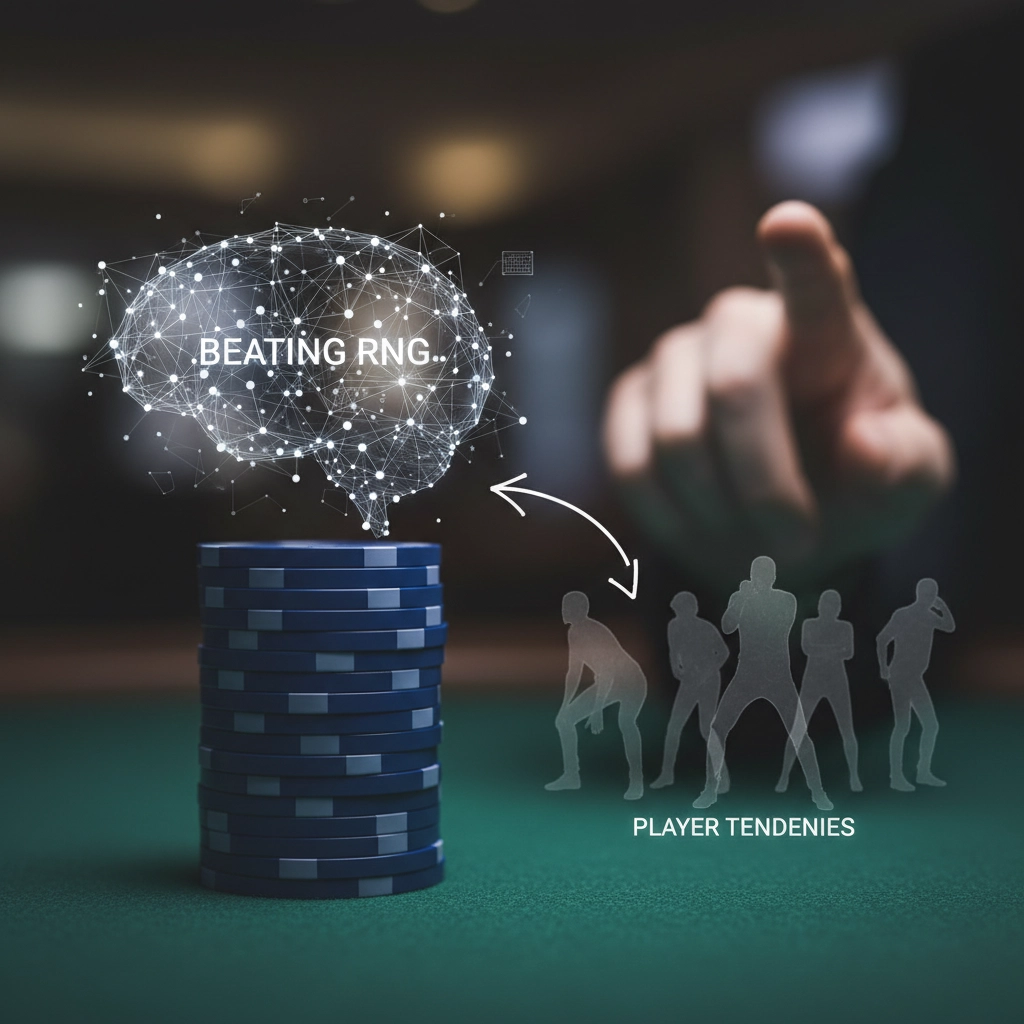
This section explains how RNG impacts decision-making and why focusing on player tendencies gives you the practical edge. You’ll learn to treat variance as a background force while actively changing your play to punish predictable opponents. The goal is not to “beat” RNG — you can’t — but to make decisions that are +EV (expected value) over thousands of hands so that RNG’s noise averages out in your favor.
How variance affects your decisions and bankroll planning
Variance in online poker is driven by the RNG, which randomizes card distribution. That randomness creates streaks of wins and losses that are statistically normal. Your job is to manage these streaks so they don’t destroy your ability to make correct decisions.
- Think in samples, not sessions. One session is a tiny sample; your edge only reveals itself over thousands of hands. Avoid overreacting to short-term results.
- Size your bankroll for the swings. Use conservative bankroll management to survive variance. The exact size depends on game type (cash, MTT, SNG) and format (fast-fold, turbo), but large samples require larger bankroll buffers.
- Use metrics to track real performance. Trackable stats (winrate, showdown frequency, fold-to-competitor aggression) tell you whether decisions are profitable long-term, not just lucky.
- Adjust session goals. Focus on making +EV plays rather than chasing short-term results. Your goal should be process-oriented: correct decisions lead to profit over time.
Accepting variance does two things: it prevents emotional reactions (tilt) and it frees you to exploit opponents rather than fight the RNG noise. When you treat bad beats as statistical inevitabilities, you’re less likely to deviate from optimal exploitative adjustments.
Spotting exploitable tendencies at online tables
Online opponents leave a lot of behavioral traces: bet sizes, frequencies, timing, and folds. You can convert these traces into exploitable patterns without trying to “out-RNG” the game. Focus on the repeatable habits that indicate weakness or predictability.
Key observables to watch and exploit:
- Continuation bet frequency (c-bet): Players who c-bet too often can be exploited by increased check-raises or by floating more often on favourable boards.
- Fold-to-3bet and 3bet frequency: A player who folds too much to 3-bets can be light 3-bet for fold equity; a player who 3-bets aggressively should be 4-bet or isolated with tighter ranges.
- Bet sizing patterns: Consistent small or large sizing on particular streets reveals range strength. Adjust your calling and continuing frequencies accordingly.
- Showdown tendencies: Opponents who reach showdown with weak holdings give you opportunities for thin value bets and to bluff less often.
- Timing tells and multi-tabling behavior: Fast automatic actions often indicate standard marginal plays; long pauses can mean tough decisions or manual thinking — adjust your assumptions accordingly.
Translate observations into actionable adjustments:
- Against a passive caller-heavy table, value-bet more frequently and thin your bluffs.
- When facing an over-aggressive reg, tighten your calling ranges and trap with strong hands; use position to exploit bluffs.
- Exploit predictable bet sizes by inducing bluffs on sizing lines that are poorly defended by opponents.
Converting reads into frequency changes
Once you identify a tendency, quantify it into a frequency change. For example, if a player folds to river aggression 75% of the time, increase your river-bluff frequency to exploit that fold rate. That kind of conversion — from qualitative read to quantitative adjustment — is how you earn consistent edges against human opponents while the RNG continues to shuffle the deck.
Next, you’ll learn how to balance exploitative changes with game-theory-aware adjustments and see concrete hand examples that illustrate when to deviate from baseline ranges and when to stick to equilibrium play.

Balancing exploitative adjustments with game-theory-aware play
Exploitative play and game-theory-optimal (GTO) approaches are not enemies — they’re tools in the same toolbox. GTO gives you a robust baseline that’s hard to punish; exploitative play extracts extra EV when opponents deviate from that baseline. Your job is to know when to lean on each approach and how far to deviate without creating a new leak your opponents can exploit.
Practical rules for balancing the two:
- Start from a sound baseline. Build preflop and postflop ranges that approximate equilibrium for your stakes and positions. Use that as your “default” so you don’t bleed chips against good opponents or when reads are thin.
- Quantify the deviation before committing. Only make large exploitative shifts after you’ve seen a clear pattern (see the sample-size guidance below). Small, incremental deviations are safer: they gain EV without radically reshaping your range.
- Consider opponent skill and adaptability. Against weak, predictable players, push exploitative lines harder (more bluffs, more light 3-bets). Against regs or frequent opponents who can adjust, favor GTO-mixed strategies to avoid being counter-exploited.
- Use selective polarization. Exploit by polarizing where it costs you least: add more value-heavy hands to thin-value situations against calling stations, or add blocked bluffs (hands with blockers to opponents’ value combinations) rather than random trash when bluffing susceptible players.
- Limit range distortions. If you deviate, retain some balanced frequency so you remain unpredictable. For example, if you stop 3-betting bluff against a player who calls too wide, continue a small percentage of bluffs to prevent them from profitably widening forever.
In short: use GTO as your backbone and exploitative adjustments as targeted scalpel cuts, not a full-scale renovation of your strategy after one session.
Concrete hand examples: when to diverge from baseline ranges
Examples make the balance actionable. Below are typical scenarios you’ll encounter and the math/logic behind the adjustments.
- Scenario — Passive caller-heavy table (CO opens, BTN calls, you BB): The BTN rarely 3-bets and calls too wide. Baseline: defend with a mix of broadways, suited connectors, and some pairs. Exploit: increase thin value bets and reduce bluffs on flops where calling tendencies favor showdown. If BTN calls flop/turn a lot, value-bet thinner on river — add hands like KJ, QJ that have decent showdown value but fold equity is minimal.
- Scenario — Aggressive 3-bettor from BTN vs your CO open: Baseline: tighten vs frequent 3-bettors and 4-bet a polarized range. Exploit: if villain folds to 4-bets 80% of the time, widen your 4-bet range substantially (more light 4-bets). If they call 4-bets and are double-barrel bluff-prone, instead tighten and trap with strong hands.
- Scenario — River bluff sizing math: Suppose pot = P and you consider bluffing with a bet size b*P. Your bluff is +EV if fold% > b/(1+b). Examples:
- Bet 1/3 pot (b = 1/3): fold% needed > 25%.
- Bet 1/2 pot (b = 1/2): fold% needed > 33.3%.
- Bet 2/3 pot (b = 2/3): fold% needed > ~40%.
If your opponent folds to river aggression 75% of the time (as in the earlier example), even small bluffs are extremely profitable — so increase river-bluff frequency on lines they respect.
Also use blockers to choose better bluffs: having an Ace on a board where your opponent’s value combos include A‑x reduces the number of hands they call with, increasing your bluff EV. Conversely, when you lack blockers, favor thinner value bets instead of bluff-heavy lines unless fold stats strongly justify aggression.
Practical routines: collect reads and update frequencies mid-session
Turning observations into lasting edges requires a repeatable routine. Treat reads like data: collect, test, and update.
- Observe and log. Make short note tags (e.g., “calls river wide,” “fast c-bettor,” “overfolds to raises”) rather than long narratives. Use HUD stats for initial triggers (fold-to-3bet, c-bet freq, showdown %).
- Set sample-size thresholds. Basic tendencies: 50–200 hands for strong preliminary reads; 200–500+ hands for confident, high-impact adjustments. If you have only a handful of encounters, probe with small, low-variance lines before committing.
- Probe with low-risk tests. Try a few size adjustments or one-off bluffs and watch responses. If the opponent continues the same pattern, escalate the exploit. If they adjust against you, consider reverting toward equilibrium.
- Review and adapt. After session, tag hands and update your mental database. Use hand-history reviews to validate assumptions and refine frequencies (e.g., adjust planned bluff frequency if the opponent’s fold% changed).
- Protect yourself from tilt and overfitting. If outcomes swing against you, revisit the underlying read rather than the results. Keep a fallback strategy: default GTO lines you trust until the read is reconfirmed.
By standardizing how you collect and act on reads, you turn noisy RNG-driven sessions into repeatable profit-making processes. The ongoing work is simple: observe honestly, quantify conservatively, probe smartly, and update when the data supports the change.
Putting strategy into practice
Mastery comes from deliberate, repeated action: set small experiments at the tables, record what works, and prevent emotional reactions from dictating changes. Treat each session as a data-gathering opportunity rather than a verdict on your skill. When in doubt, default to a solid baseline and escalate only when the evidence supports a deviation. For tools and structured drills, consult GTO solvers and learning resources to practice frequency awareness and equity calculations away from the heat of the table.
- Pick one exploit to test per session (e.g., thinner river value bets vs calling stations) and record outcomes.
- Keep sample-size thresholds in mind: treat 50–200 hands as an initial signal and 200–500+ as stronger confirmation for major adjustments.
- Review hands weekly: tag clear misreads and successful exploits so your database of tendencies grows.
- Protect your stack and mindset: revert to equilibrium lines if opponents adjust or your confidence drops.
Frequently Asked Questions
How many hands do I need before making a significant exploitative adjustment?
Use 50–200 hands for a preliminary read and 200–500+ hands for high-confidence, high-impact adjustments. If your encounters with a specific opponent are limited, probe with low-variance tests (small sizing changes, one-off bluffs) before committing to a large strategy shift.
When should I prioritize GTO play over exploiting an opponent?
Prioritize GTO when opponents are competent and adaptable, when reads are thin or conflicting, or when you face silver-level and above regulars who will adjust quickly. Lean more toward exploitative play when an opponent shows consistent, measurable deviations that persist over sufficient sample size.
How should blockers affect my bluffing decisions?
Blockers increase bluff EV because they reduce the number of strong hands your opponent can hold. Prefer bluffs with meaningful blockers (e.g., an Ace on a board where opponents need A‑x) and reduce random, blocker-less bluffs unless your opponent’s fold stats clearly justify aggression.