
Why poker rivalries still capture your imagination
You don’t just watch cards being dealt; you watch human drama unfold. Rivalries turn individual hands into chapters of a wider story—personal style, competing philosophies, and repeated clashes over years or decades. Understanding those rivalries helps you read the game beyond math and tells you why certain hands, faces, and tables became legendary.
Rivalries matter for several reasons: they create narrative tension for spectators, they push players to innovate strategically, and they often coincide with pivotal changes in the game—like the rise of organized tournaments and televised poker. When you study these rivalries, you’re learning poker history through the interpersonal battles that accelerated it.
The first great duel: Nick “The Greek” vs. Johnny Moss
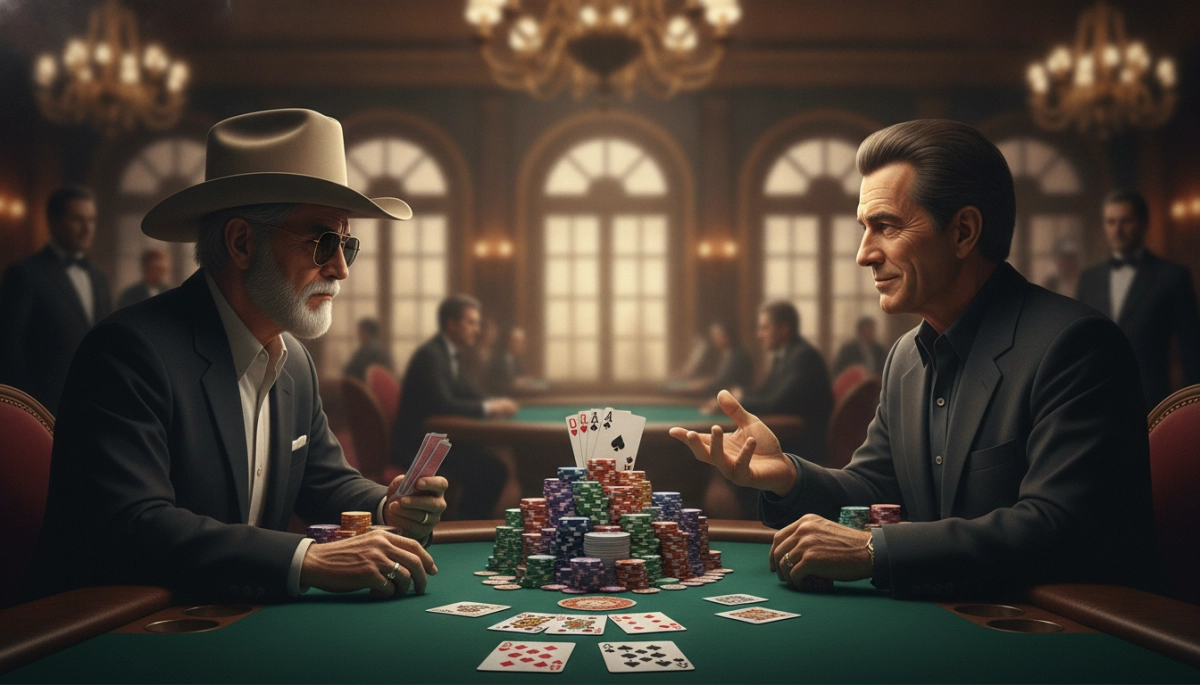
One of the earliest, most storied rivalries is the epic heads-up between Nick “The Greek” Dandolos and Johnny Moss. The match—recounted in countless poker histories—symbolizes an era when the game lived in back rooms, private clubs, and on the fringes of mainstream sports.
- High stakes, high drama: You can picture the stakes: money on the line, reputations at risk, and a long, grueling duel that was as much about endurance as skill.
- Styles in contrast: Nick embodied the gambler’s bravado; Moss represented the seasoned pro who survived by making disciplined, small-edge decisions. That contrast framed the match as brains versus bravado.
- Legacy: Whether every detail of the story is perfectly accurate or not, the match crystallized the idea that poker could produce heroes and villains—an essential element for later rivalries.
How the World Series of Poker turned grudges into headlines
When the World Series of Poker (WSOP) began to formalize tournament poker in the 1970s, it created a new arena for rivalries to develop and be documented. You’ll find the seeds of many modern feuds in this era—players who met repeatedly on the biggest stages, fought for bracelets, and traded barbs in interviews.
Think of the WSOP years as the laboratory where styles clashed repeatedly: the tight-aggressive pros versus the loose entertainers, the living legends like Johnny Moss and Doyle Brunson who had already built reputations, and the young challengers looking to claim their space. The structure of repeated tournaments meant grudges could be renewed annually, and victories would accumulate into long-term narratives.
In the next section, you’ll see how televised poker and the 1980s–90s competitive scene amplified personal rivalries—introducing new names, dramatic final-table showdowns, and moments that defined careers.
Television puts faces on the game: 1980s–90s rivalries go mainstream
Once poker moved from smoky backrooms to television sets, personal clashes acquired a new dimension: they weren’t just reputations whispered around felt tables, they were theater. Broadcasts and taped final tables turned mannerisms, table talk, and one-liners into cultural touchstones. The dramatic 1980s and 1990s saw established pros lock horns in public ways that amplified grudges and created instant heroes.
Consider the rise of younger challengers against old-school champions. Phil Hellmuth’s 1989 Main Event victory—earning him the moniker “The Poker Brat”—wasn’t just a tournament win; his outspoken rivalry with veterans like Johnny Chan and Doyle Brunson became part of the story people tuned in to watch. Hellmuth’s emotional outbursts and tendency to insult opponents made for broadcast gold and framed subsequent hands as grudge matches.
Televised shows also presented recurring pairings—players who met repeatedly on final tables and heads-ups. That repetition let audiences track momentum, trash-talk, and strategic evolution. Television popularized memorable moments (a taunt, a daring bluff, a cold-call hero) and turned them into shorthand for entire rivalries. For viewers, the game became a soap opera as much as a sport.
The Poker Boom and the online revolution: amateurs vs. pros, avatars vs. legacies
When Chris Moneymaker’s improbable 2003 Main Event victory proved an amateur could go all the way, the game exploded. The poker boom remade rivalries: suddenly the field contained not just touring pros but qualifiers from kitchen tables and keyboards. Moneymaker’s heads-up with Sam Farha symbolized that shift—an everyman taking on a seasoned professional on the biggest stage.
At the same time, the internet created new arenas. Online pseudonyms and 24/7 cash games produced lightning-fast feuds. Players like Tom “durrrr” Dwan and Patrik Antonius, or Viktor “Isildur1” Blom and Gus Hansen, battled for astronomical pots on sites and in televised high-stakes cash-game shows. Those clashes mixed the inscrutability of screen names with the rawness of huge monetary swings; when identities were revealed, the mythology grew.
Forums, blogs, and later-streams let fans track every hand and amplify perceived slights or stylistic differences. Rivalries no longer lived only in casinos—they percolated through comment sections and chat rooms, accelerating narratives and cementing reputations overnight.
Social media, high stakes, and the modern era of public duels
Today’s rivalries play out across livestreams, YouTube, and Twitter as much as they do at the felt. High-stakes cash games remain a proving ground, but social-media callouts, challenge matches, and sponsored heads-ups have made one-on-one rivalry a content engine. Daniel Negreanu and Doug Polk, for example, turned disagreement into a high-profile heads-up match that blended poker skill with public theater—Polk’s eventual win became a contemporary chapter in the rivalry playbook.
Modern feuds are often ideological: GTO proponents versus exploitative “reads” players; streamers who build brands around trash-talk versus old-school pros who value stoicism. The result is a pluralistic rivalry landscape—part professional competition, part media strategy—where every big pot can be a headline and every handshake an episode in an ongoing saga.
What the future deals: rivalries in the years ahead
Rivalries in poker will continue to be less about the cards and more about people — how they adapt, how they perform under pressure, and how they use new platforms to amplify every victory and slight. As formats multiply (live streams, sponsored heads-up duels, and AI-assisted analysis), the contours of those rivalries will change, but the underlying human drama will remain the same: pride, persistence, and the search for edges both small and decisive.
Where to watch and what to expect
- High-profile tournaments like the World Series of Poker will keep creating headline moments where rivalries can be renewed on the biggest stages.
- Live streams and content creators will turn friction into ongoing narratives, letting fans follow a rivalry hand-by-hand and voice-by-voice.
- Specialized heads-up events and challenge matches will offer distilled, personality-driven contests that often matter as much culturally as they do financially.
- Advances in analytics and AI will pressure players to evolve, turning strategic disagreements into new public feuds over theory and application.
Ultimately, watching great rivalries is a way to learn poker’s craft and to witness the human stories that keep the game compelling. Whether you’re a student of strategy or a casual fan, the next great poker feud is probably already forming — and it will be worth watching unfold.