


Make faster calls by knowing the official hand order cold
You need to move quickly at the table. Whether you play Texas Hold’em, Omaha, or a friendly home game, the single most important mental shortcut is a solid, instant recall of the five-card hand rankings and how ties are broken. When you can name the value of a hand in one glance, you avoid hesitation, reduce costly mistakes, and focus on strategy rather than basic rules.
This part lays out the ranked list you should memorize, explains a few key technical points (like how the ace functions in a straight), and shows examples to make each rank unmistakably clear. Use this as your mental checklist: when you see your cards and the board, run through the list from top to bottom and stop as soon as you hit a match.
Top-to-bottom poker hand rankings with quick examples
Here is the ordered list you must have at hand. Read the short example beside each rank to build instant recognition. Remember: most poker variants use the best five cards to make a hand.
- Royal Flush — A, K, Q, J, 10 all of the same suit. Example: A♠ K♠ Q♠ J♠ 10♠. This is the highest possible hand.
- Straight Flush — Five consecutive cards of the same suit (not the royal). Example: 9♥ 8♥ 7♥ 6♥ 5♥.
- Four of a Kind (Quads) — Four cards of the same rank plus any fifth card. Example: Q♦ Q♣ Q♥ Q♠ 3♣.
- Full House — Three of a kind plus a pair. Example: 7♠ 7♣ 7♦ 2♠ 2♥ (called “sevens full of twos”).
- Flush — Five cards of the same suit, not consecutive. Example: A♥ J♥ 9♥ 6♥ 3♥.
- Straight — Five consecutive cards of mixed suits. Example: 10♣ 9♦ 8♠ 7♣ 6♥. Note: A-2-3-4-5 is the lowest straight (called a “wheel”) where the ace plays low.
- Three of a Kind (Trips) — Three cards of the same rank plus two unrelated side cards. Example: 5♣ 5♦ 5♠ K♠ 2♥.
- Two Pair — Two different pairs plus one kicker. Example: J♣ J♦ 4♠ 4♥ 9♣ (jacks and fours).
- One Pair — Two cards of the same rank plus three kickers. Example: A♦ A♣ 10♠ 7♥ 2♣.
- High Card — When none of the above is made, the highest card determines the hand. Example: K♠ 10♦ 8♥ 5♣ 2♦ (king-high).
Quick tie-breaker rules you can recall instantly
When two players have the same category, standard tie-breakers decide the winner:
- Compare the highest-ranked card(s) that create the combination (e.g., higher four-of-a-kind wins).
- For full houses, compare the three-of-a-kind first, then the pair.
- For flushes and high-card ties, compare the highest card of the five, then the next highest, and so on.
- Straights are compared by their highest card (A-2-3-4-5 is the lowest straight). Suits do not rank above each other in normal poker rules.
Remembering the “best five” rule and community-card play
In community-card games like Texas Hold’em, you always make the best five-card hand from your two hole cards plus the five community cards. That means sometimes the board itself makes the best hand for multiple players; when the board is the best five, the pot is split. Keep this in mind when you evaluate your hand quickly: ask yourself, “Is my hole card improving the board, or am I just playing the board?” This distinction saves time and prevents miscalls.
Now that you have the ranked list, examples, and the quick tie-breaker rules ready to use at the table, you can start practicing speed recall and apply simple mnemonics to lock these in—next, we’ll build a one-line printable cheat sheet and share memory tricks and table-ready shorthand to make snap decisions under pressure.
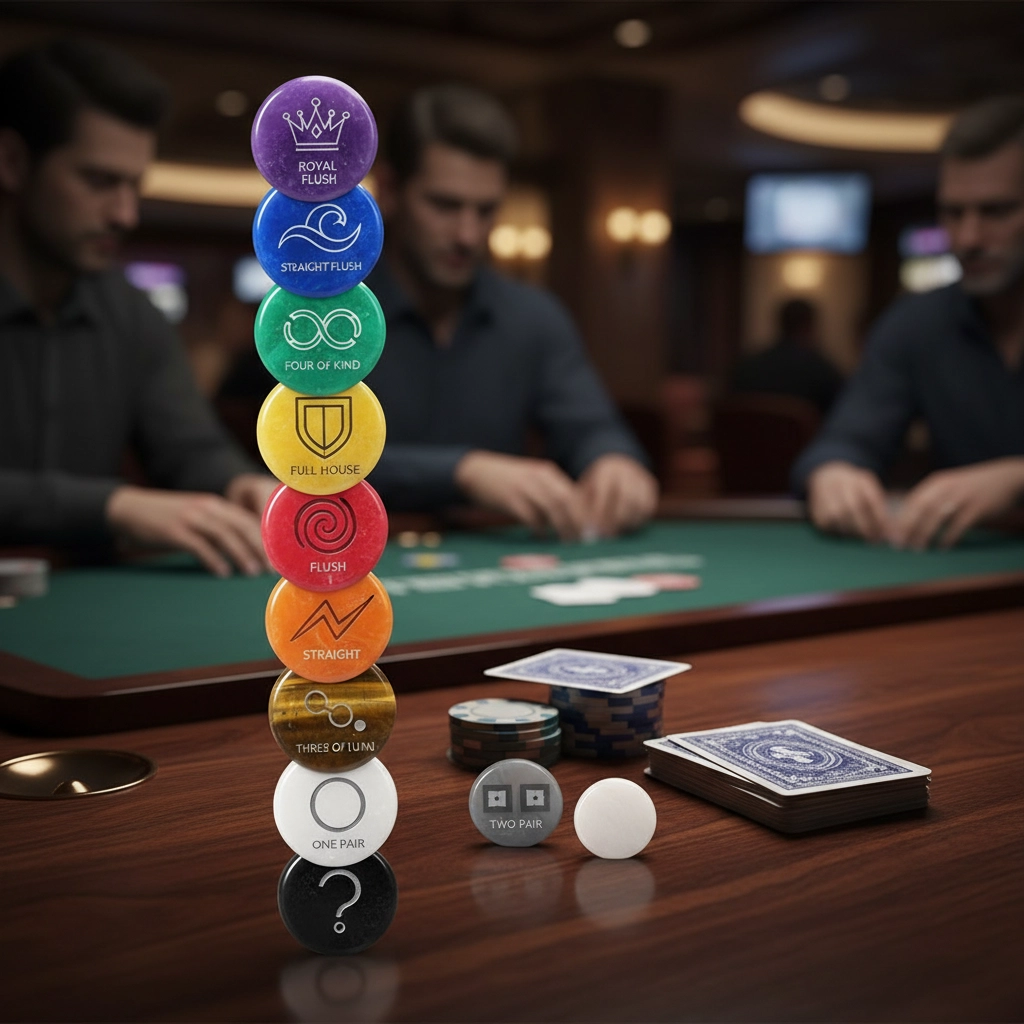
One-line printable cheat sheet you can carry or memorize
Make a single, compact line that your eyes can skim in under a second. Put this on a small card, phone note, or tattoo it onto your mental index finger: read left-to-right and stop when you see a match.
Cheat line (two options — pick the style that sticks for you):
– Plain words: Royal Flush → Straight Flush → Four of a Kind → Full House → Flush → Straight → Three of a Kind → Two Pair → One Pair → High Card
– Short code: RF → SF → 4K → FH → F → S → 3K → 2P → 1P → HC
How to use it at the table:
1. Glance at your hole cards and the board.
2. Run the cheat line from the left. Ask, “Do I have a Royal?” No → “Straight Flush?” No → continue until you hit a yes.
3. When you hit a match, apply the tie-breaker rule for that category (e.g., compare quads’ ranks, compare highest card in flushes). If none of this improves your hand relative to the board, stop — you’re playing the board.
Add a one-line tiebreak reminder on the reverse of the card:
– Quads: higher rank wins.
– Full house: compare trips then pair.
– Flush/high-card: compare highest, then next highest, etc.
– Straight: highest card wins (wheel = A-2-3-4-5 is lowest).
Keeping the cheat line visible as a micro-checklist prevents wasted brain cycles and reduces hesitation when you’re under time pressure.
Memory tricks and table-ready shorthand to lock it in
Pick one or two of these techniques and practice them until they’re automatic. The goal is to make recognition reflexive — not something you think about.
Chunking + imagery
– Chunk the list into three bands: monster hands (Royal, Straight Flush, Quads), strong hands (Full House, Flush, Straight), regular hands (Trips, Two Pair, One Pair, High Card). Visualize three piles on a shelf: crown on top, stacked house in the middle, lone cards on the bottom.
– Create a quick visual story: a king (royal) rides a single-color horse (flush) through a house with four windows (quads), then meets three roommates and two guests (full house). Vivid, silly images stick.
Phrase mnemonics
– Make a short sentence that follows the order. Example: “Royal Sailors Find Four Fully Fitted Sailing Trips Toward Pairing Highs.” It’s odd but the order of key words cues the hand ranking. Keep your own version that makes you smile — personal hooks work best.
Abbreviation practice (table shorthand)
– Use the short code RF, SF, 4K, FH, F, S, 3K, 2P, 1P, HC as your mental scan. Say the first letter(s) quietly once as you look: “RF? SF? 4K?” The repetition builds reflex.
– For tie logic, keep tiny abbreviations: 3>2 (full house compare 3 then 2), K1,K2,K3 (flush/high-card compare highest to third), STR-H (straight = compare high).
Muscle memory drills
– While shuffling or holding your chips, recite the cheat line quickly out loud ten times. Pair it with a physical action (tap the table on the last word). The movement links the phrase to a motor pattern so recognition speeds up.
– Do “hand flash” drills: flip five-card hands from a pre-made stack and name the ranking in under 3 seconds. Gradually lower the target time.
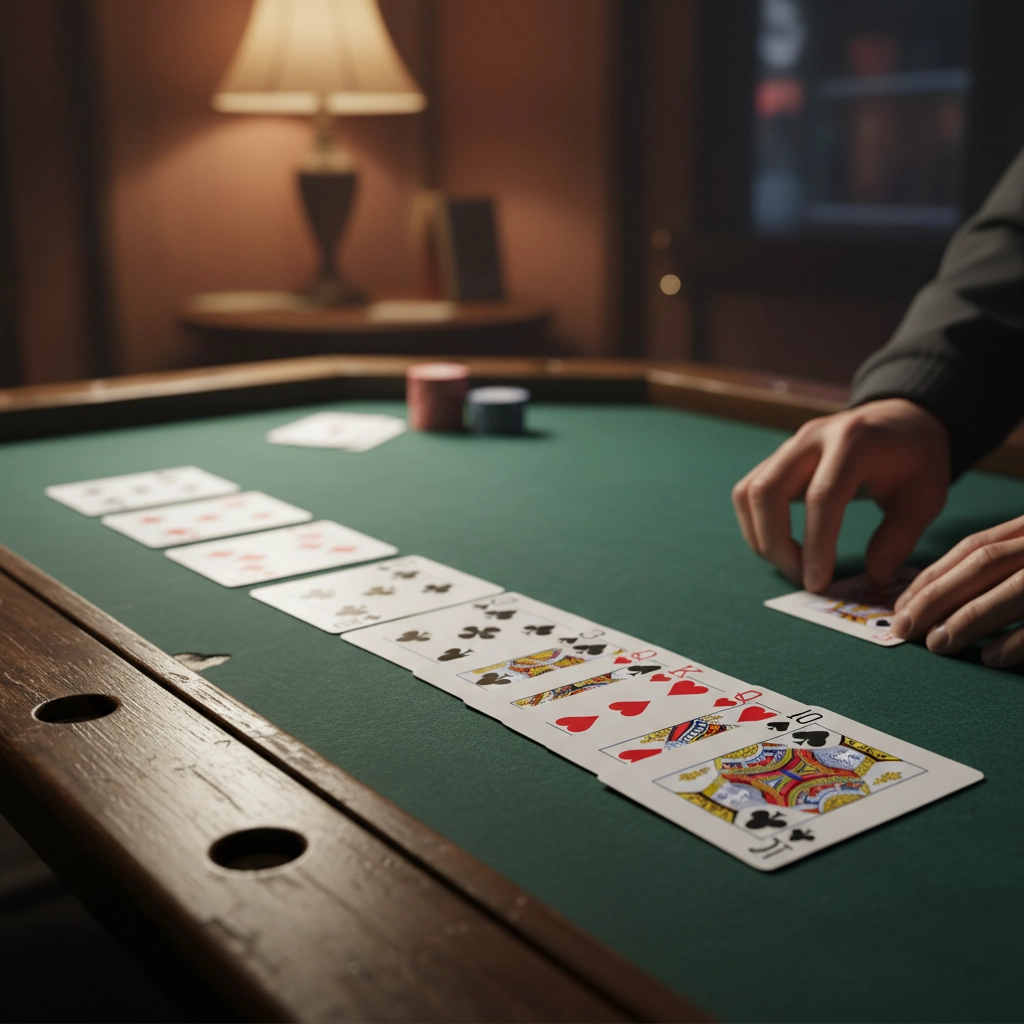
Speed-practice drills to make this automatic at the table
Timely practice beats passive reading. Use short, focused drills designed to mimic table pressure.
Timed recognition rounds
– 30/60/90 drill: Set a 1-minute timer and deal or flip 10 five-card hands. Aim to name each in under 3 seconds in the first round. Repeat until you can do 10 hands in under 30 seconds total. Decrease target time incrementally (10 hands in 20s, then 10s).
Community-card simulation
– Deal five-board cards and two hole cards (real or virtual). Within 5 seconds, call the best five-card hand and whether your hole cards improve the board. Increase speed as you improve. This practice directly trains the “am I playing the board?” check that saves mistakes.
Live table tempo practice
– Sit in a low-stakes game or play a fast online ring/short-handed table. Force yourself to use only the cheat line — no long deliberation. If you’re slowed by doubt, fold a few hands deliberately; the goal is speed and accuracy, not results.
Quick review habit
– Before each session, run the one-line cheat sheet and the tie-break bullet points once. That 10-second warm-up primes recall and reduces hesitation in the first few orbits.
Combine these drills with the micro-cheat card and shorthand until you reach reflex speed. With consistent short practice, you’ll move from “thinking through” the ranks to instantly recognizing them — and that speed is what wins you pots when decisions must be made in a heartbeat.
Final quick tips and next steps
Make the cheat line and tiny tie-break reminders part of your pre-session ritual. Small, repeatable actions beat long study sessions when the goal is speed: a 10-second warm-up, a pocket note on your phone, and three fast drills before play will prime reflexes.
- Print or save a one-line cheat card and a one-line tiebreak list to carry with you.
- Schedule three short practice bursts per week (5–10 minutes each) instead of one long session.
- When you start a real table, force one orbit where you use only the cheat line — accept a few tactical mistakes in exchange for building speed.
- If you want a reference for standard hand hierarchy, consult a reliable guide such as Poker hand rankings.
Keep the focus on recognition, not on overthinking. With the cheat line and a handful of rapid drills, speed becomes automatic — and that puts you in the right position to make decisive plays when it matters.
Frequently Asked Questions
How do I quickly tell if I’m “playing the board”?
Scan the cheat line: if none of the left-to-right categories requires a hole card to beat the five community cards, you’re playing the board. If your hole cards don’t improve the best five-card combination available on the board, treat your hole cards as irrelevant for showdown decisions.
What’s the fastest way to remember tie-breaker rules?
Use a two-line card: top line = cheat line; bottom line = micro tiebreaks (e.g., Quads: rank, FH: trips>pair, Flush/HC: compare highest cards left-to-right, Straight: highest card wins). Drill the bottom line in short bursts until you can recite it without thinking.
Can I use this cheat sheet in live tournaments and online play?
Yes. The cheat sheet is a personal memory aid and practice tool. In live tournaments, ensure you follow tournament rules about notes and devices at the table; most low-stakes games and online play allow private notes. The key is internalizing the line so you rely less on external prompts over time.