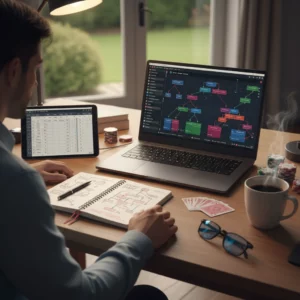


Why a daily poker study plan pays off for your game
If you want steady improvement instead of sporadic breakthroughs, a consistent study routine is essential. Daily study forces you to convert raw play into durable skill by closing leaks, expanding strategy, and reinforcing decision-making patterns. When you make study habitual, you reduce tilt-driven mistakes, sharpen range construction, and learn to convert small edges into long-term profit.
How a routine wins more hands than talent alone
Talent can give you early success, but disciplined practice compounds skill. You’ll learn to recognize patterns faster, exploit opponents more reliably, and make better decisions under pressure. A structured plan also helps you avoid common pitfalls: unfocused review, jumping between topics without mastery, and ignoring the psychological side of the game.
Design a realistic daily routine you’ll actually keep
Your plan should be practical, measurable, and tailored to your schedule and goals. Aim for consistency over duration: short, focused sessions every day beat marathon reviews once a week. Break study into complementary activities—concept learning, hand analysis, drills, and mental training—so you develop both knowledge and execution.
Set clear weekly goals and micro-sessions
- Define one weekly skill focus: e.g., preflop ranges, c-bet strategy, river bluffing, or ICM decisions. This keeps your study deep rather than scattered.
- Daily micro-goals: 30–90 minutes split into 2–3 blocks (theory, analysis, drills). Short blocks maintain attention and aid retention.
- Track progress: log what you studied, insights learned, mistakes fixed, and measurable outcomes like win-rate changes or error reduction on similar hands.
Sample time allocation and practical tasks
- 15–30 minutes — Concept study: read a high-quality article or watch a focused video about your weekly focus. Take one note of how it changes decisions you make at the table.
- 20–40 minutes — Hand review: review recent hands (use your hand history) and identify specific mistakes. Tag recurring leaks and create corrective action items.
- 15–30 minutes — Drills and solver work: use solver outputs, equity trainers, or range drills to practice concrete spots. Repeat the same drills for several days to build pattern recognition.
- 5–10 minutes — Mental checklist: before play, run through tilt-control cues, bankroll limits, and session objectives to align mindset with skill.
Keep the routine flexible: on busy days, prioritize one short focused block; on freer days, combine two. The next part will show a detailed daily schedule, specific drills and tools you can use, and how to measure improvement week by week.

A daily schedule you can actually stick to (two templates)
Below are two practical schedules you can adapt: one for players with a day job and one for full-timers. Both preserve the micro-session structure and ensure deliberate practice before and after play.
Part-time player (60–90 minutes total)
– 06:30–06:45 — Quick concept read/video: one short article or a 10–15 minute focused video on the week’s theme. Note one concept to apply.
– 20:00–20:30 — Hand review & tagging: import the day’s biggest hands into your HUD or tracker, tag leaks, and write one corrective action per hand.
– 20:30–20:45 — Drill: equity drills or a solver spot drill (see drills section). Finish with a 2–3 minute mental checklist for tomorrow’s session.
Full-time player (2–3 hours total)
– 09:00–09:20 — Deep concept study: one chapter, a long-form article, or solver output for the weekly focus. Create an “actionable change” list.
– 12:00–13:00 — Practice block: short online session practicing the new concept (e.g., applying a revised 3-bet frequency).
– 18:30–19:00 — Structured hand review: annotate 20–30 interesting hands. Flag recurring patterns.
– 19:00–19:30 — Solver/drill time: run a handful of spots through GTO+ or PioSolver and translate recommendations into simplified rules.
– 19:30–19:40 — Cooldown: update your study log, set tomorrow’s micro-goal, and run the tilt-control checklist.
Adjust the timing: on heavy play days move more study to pre- or post-session micro-blocks. The point is consistency of targeted effort, not total hours.
High-impact drills and tools to accelerate learning
Focus on drills that create automatic responses to common spots. Rotate a small set repeatedly until the patterns become second nature.
Drills
– One-Spot Repetition: pick a single frequently-occurring decision (e.g., OOP c-bet on A-high dry boards). Run 50 solver instances, summarize the optimal frequency/size, then practice playing 20 hands with that rule.
– Frequency Flashcards: create quick cards showing ranges and ask yourself the correct bet/check/fold frequency — aim for 90% accuracy under 5s.
– Equity Push-ups: 30 random hand-vs-range equity calculations with Equilab or Flopzilla to speed recognition.
– Leak Re-test: after you identify a leak, set a 2-week re-test where you intentionally seek hands of that type and record whether the new approach was used.
Tools
– GTO+: fast, affordable solver for spot work.
– PioSolver / GTOx: for deeper solver output when you need precision.
– Flopzilla / Equilab: range visualization and equity drills.
– PokerTracker or Hand2Note: import hands, tag leaks, and run filters.
– ICMIZER / MonkerSolver: mandatory for tournament/ICM-heavy work.
– Simple spreadsheets or Trello: track weekly focuses, tagged hands, and progress.
Don’t just read solver output — translate it into rules like “c-bet 45% on this texture with sizing X” so you can execute at the table.
Measure improvement week by week and adapt your focus
Improvement requires measurable signals and willingness to pivot when data disagrees with assumptions.
What to track
– Table metrics: bb/100 over filtered sample sizes, non-showdown win rate, showdown win rate, average pot size. Use rolling 10k-hand windows for cash; per-month ROI for tournaments.
– Leak metrics: count of specific mistakes per 100 hands (e.g., missed c-bets, wrong fold-to-3bet).
– Execution rate: how often you followed the corrective action in tagged hands.
Weekly review routine (30–60 minutes)
– Pull key metrics and compare to previous week.
– Review 5 representative hands: one clear mistake, one close decision, one successful application.
– Decide: maintain focus, intensify it, or switch to a new weekly skill. Limit changes to one new focus per week.
When results are noisy, prioritize process metrics (execution rate, leak frequency) over short-term winrate swings. If the process improves consistently, the results will follow.

Putting the plan into action
Turn planning into momentum: pick one small, specific change you can apply at the tables this week, schedule micro-sessions into your calendar, and commit to tracking execution. Progress in poker is a chain of tiny improvements — not sudden reinventions — so prioritize consistency, honest self-review, and deliberate repetition. Use tools to translate complex solver output into simple rules you can actually use in-game, then build drills around those rules.
- Day 1: choose your weekly focus and set three micro-goals (concept, review, drill).
- Day 2–6: follow your micro-session schedule, log hands and execution rates, and run one focused drill daily.
- Day 7: run the weekly review and decide whether to continue, intensify, or shift focus.
If you want a practical solver for spot work, consider testing a dedicated tool like GTO+ to speed up drill creation and range visualization. Above all, be patient: steady, measured effort compounds into reliable edges at the tables.
Frequently Asked Questions
How quickly will I see improvement if I follow a daily study plan?
Visible changes depend on starting level, volume, and quality of study. You can usually notice clearer decision-making and fewer repeatable mistakes within 2–4 weeks if you consistently apply a focused weekly theme and track execution rates. Monetary results may lag; prioritize process metrics first.
How should a beginner structure their first four weeks?
Start with fundamentals: week 1 — basic preflop and position play; week 2 — continuation betting and board textures; week 3 — bet sizing and pot control; week 4 — simple postflop hand-reading and range narrowing. Keep daily sessions short (30–60 minutes), focus on one concept each week, and review tagged hands every night.
How much solver work is appropriate for cash games versus tournaments?
For cash games, use solver work to refine common spots and create simplified rules (frequency and sizing) you can apply broadly. For tournaments, allocate more time to ICM and bubble-specific spots using tools like ICMIZER or MonkerSolver. In both formats, balance solver study with real-play drills and hand reviews so theory translates into execution.