


How real-money online poker changes the way you should think about the game
When you move from casual or play-money tables to real-money online poker, everything from your emotional approach to your technical decisions needs to tighten up. Real stakes amplify variance and make small edges more valuable — a 1% improvement in decision-making can separate a losing player from a winning one over time. You should treat the game as a skill-based investment: manage risk, build consistent processes, and learn to exploit typical online tendencies like looser preflop calling and frequent multiway pots.
Online play also introduces elements that don’t exist at the live felt: faster pace, HUD (heads-up display) data, multi-tabling, and greater sample sizes of hands. Those differences create both opportunities and traps. For example, speed and multi-tabling can inflate your hourly results but also increase fatigue and errors. Data tools can reveal opponents’ leaks, but relying on them without strong fundamentals can lead to overfitting and poor in-session adjustments.
Key mental and practical adjustments when real money is involved
- Emotional control: You’ll need stricter tilt management because real losses feel very different. Adopting pre-session rituals and stop-loss rules prevents poor decisions after a bad beat.
- Variance awareness: Expect swings. You should separate short-term results from long-term skill and measure your progress by ROI and win-rate over thousands of hands, not a single session.
- Time management: Choose session lengths that preserve your focus. Many winning online players limit multi-tabling and use scheduled breaks to maintain accuracy.
- Record keeping: Track stakes, formats, and opponents’ tendencies. Simple session notes and hand histories accelerate learning more than intuition alone.
Practical foundations: bankroll, starting hands, and position
Before you dive into advanced concepts, secure the basics that protect your longevity and maximize every decision’s expected value. Think of these items as the foundation of a profitable online poker game: conservative bankroll rules, disciplined starting hand selection, and exploiting position. Neglect here costs you more than mistakes later in multi-street decisions.
Bankroll management: how much to bring to the table
Bankroll rules are simple to state but essential to follow. For cash games, aim for at least 20–30 buy-ins for the stake you play (more if you’re prone to tilting or face tough competition). For tournaments and MTTs, the variance is higher — 100 buy-ins or more for your average entry is a prudent baseline. Using these guidelines ensures you can weather downswings and continue to make +EV choices rather than being forced into desperation moves.
Starting hand selection: quality over quantity
One of the fastest ways to improve your win-rate is pruning marginal preflop hands. Tighten your opening ranges and widen them only when position, table dynamics, or stack sizes justify it. As a rule of thumb:
- Early position: play premium hands and strong broadways.
- Middle position: add more suited connectors and medium pairs selectively.
- Late position: expand your range to include speculative hands and steals, especially if the blinds are passive.
- Small blind: be protective; defend against steals but avoid playing large pots OOP with marginal holdings.
Remember that hand strength is relative to opponents’ tendencies. Versus passive fields you can value-bet thinner; versus aggressive, unpredictable players you should tighten and extract value with stronger hands.
Position: the single most profitable edge
Position beats cards more often than people realize. When you act last, you get additional information, control pot size, and can apply pressure with greater profitability. You should be willing to fold more often out of position and exploit late position by increasing raises and continuation bets. Designing your ranges around position — tighter early, wider late — creates simpler, higher-EV decisions throughout the hand.
Beyond these technical foundations, other early priorities include table selection, understanding rake and its effect on strategy, and developing a baseline aggression level. Each of these supports your ability to convert good decisions into long-term profit, so you should practice them deliberately rather than relying on intuition alone.
Next, you’ll explore how to read opponents, adjust to common online player types, and use aggression and pot control to turn those reads into consistent winnings at real-money tables.
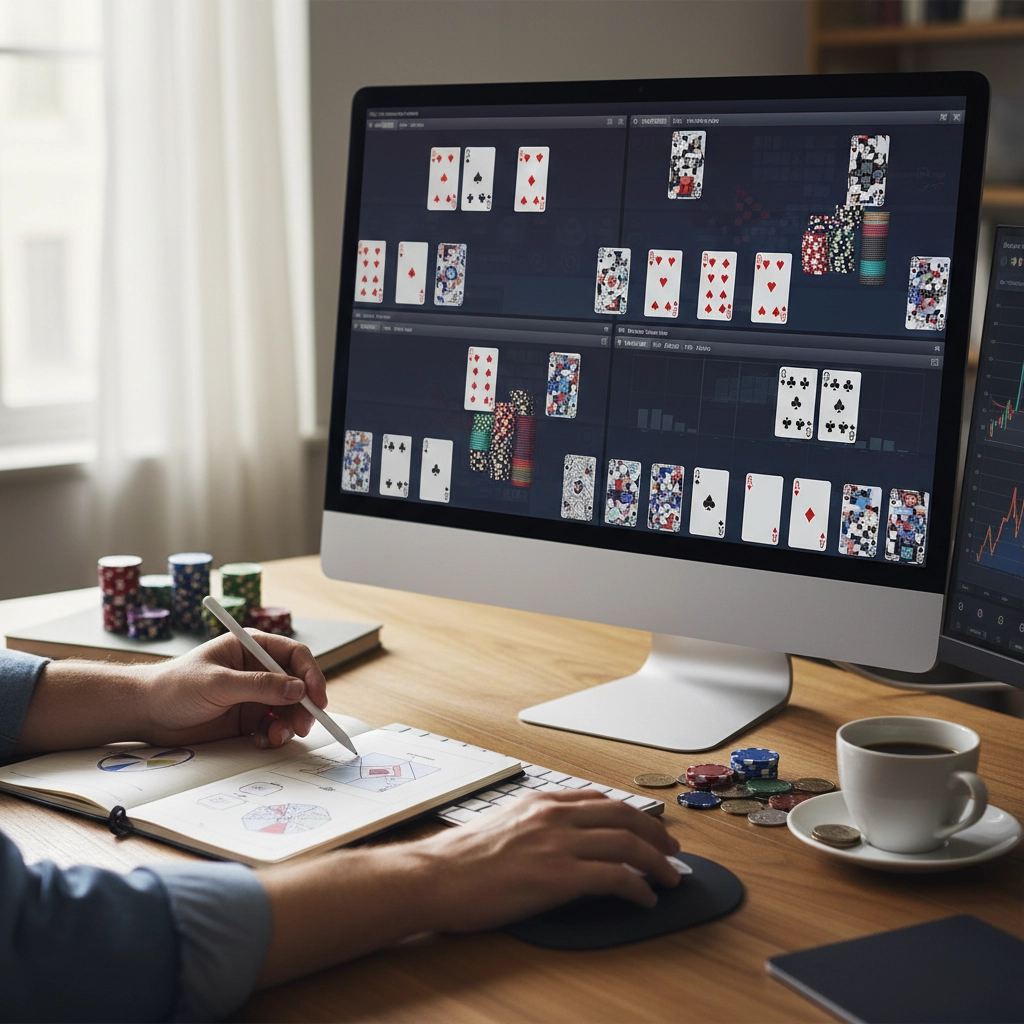
Reading opponents and adjusting to common online player types
Online opponents are easier to categorize than at live tables because patterns are amplified by volume — players tend to fall into repeatable archetypes. Instead of trying to profile every nuance, learn the 4–6 basic types and the exploitable tendencies that come with them. Common useful categories are:
- Passive calling stations: high VPIP, low PFR, call down light. They rarely fold to aggression postflop.
- Loose-aggressive (LAG) players and maniacs: raise and bluff often, apply pressure, and give up on marginal boards sometimes.
- Tight-aggressive (TAG) regulars: disciplined ranges, good positional awareness, and strong hand selection.
- Rocks / nitty regs: very tight preflop, but rarely bluff — value-bet heavily when they show interest.
- Passive-fit-or-fold players: Limp or call preflop, fold to large turns; decent to exploit with isolation raises and larger turn bets.
How you adjust:
- Versus calling stations: stop bluffing so much. Shift toward thinner value-betting and larger bet sizes when you have a hand. Avoid elaborate multi-street bluffs unless you have significant blocker combinations and backup equity.
- Versus maniacs/LAGs: tighten up marginal holdings and value-bet more. Let them bluff-shove into you when you hold top pair or better. Use positional check-raises selectively against predictable barrels.
- Versus TAGs and competent regs: mix in deception (balance blockers, occasional check-raises, well-timed floats) and avoid predictable frequency leaks — e.g., don’t c-bet blindly on every flop in position.
- Versus nitty players: widen your opening ranges and steal more often. When they enter a pot, give them credit and extract value with strong hands.
Remember to grade opponents by sample size. A 20-hand “calling station” tag is noise; 200+ hands is actionable. Use short, direct table notes (e.g., “calls down,” “c-bets rarely,” “3bets light”) so you can recall tendencies mid-session without overthinking.
Aggression, pot control, and sizing to maximize EV
Aggression wins online if used with intention. But aggression without plan is just variance. Every bet should serve one of three purposes: build the pot for value, protect equity, or generate fold equity. Choosing the right size and when to slow-play are where big differences in win-rate appear.
Preflop sizing basics (practical defaults):
- Open-raise: 2.2–3 big blinds on most online sites (use slightly larger sizes in short-handed games or when facing frequent steals).
- 3-bet: ~2.2–3x the open raise in cash games; increase sizing against shallow stacks or very aggressive opponents to isolate.
- 4-bet: size to polarize — either a shove with short stacks or a committed 2.2x–2.5x of the 3-bet depending on ranges and stack depths.
Postflop sizing and pot control:
- Continuation bets: default to 30–50% pot on dry boards and single-opponent pots to conserve equity and set up later streets. Use 60–100% pot on wet boards or against players who call small bets frequently to protect hand equity.
- Polarized vs merged sizing: when betting with a polarized range (big value + bluffs), use larger sizes to maximize fold equity. When betting with a merged range (many medium-strength hands), smaller sizes reduce opponent’s correct calling frequency.
- Pot control: check and call more with medium-strength hands and draw-heavy marginal holdings when out of position. In position, use smaller bets to keep worse hands in and control the pot size.
- Turn planning: always have a multi-street plan. If you bet flop intending to barrel the turn, consider how the turn card interacts with both your range and the opponent’s. Don’t auto-barrel — choose turns that add fold equity or improve your equity.
Bluffing checklist: blocker cards, perceived range, pot size, opponent type, and back-up plan. If you lack blockers and the opponent is a calling station or multiway pot is present, folding is often correct. When bluffing, size to maximize fold equity relative to the pot and consider a polarized line that makes folding most of the opponent’s range profitable.

Using HUDs, notes, and review to convert reads into repeatable profit
Data tools are powerful, but only when used correctly. Your HUD should show a few concise stats that directly inform decisions: VPIP, PFR, 3-bet, fold-to-3-bet, c-bet (flop), fold-to-cbet, WTSD (went to showdown), and aggression frequency. Don’t cram your HUD with dozens of stats you won’t act on — simplicity produces faster, better decisions.
Practical habits for data-driven improvement:
- Set meaningful pop-up ranges for different stat profiles so you can see default ranges when you have sufficient sample size.
- Take short, specific notes during sessions and tag hands for later review (e.g., “fold-to-3bet exploit,” “overfolds turn”).
- Regular review: run filters to study hands against each archetype — how do your results change versus high VPIP/low PFR players versus low VPIP/high PFR players? Look for systematic leaks (over-bluffing, under-3betting, poor river folds).
- Use solvers and equity calculators selectively. Start by checking close spots and big mistakes rather than trying to solution-every-hand. Solvers are tools to build intuition, not a rulebook for every table decision.
Finally, structure your review sessions. Focus on one leak at a time, set measurable goals (e.g., “reduce fold-to-3bet by 10% in late position”), and track progress across thousands of hands. Over time these small, targeted adjustments — informed by HUDs, notes, and solver checks — compound into substantial ROI improvements.
Putting strategy into practice
Winning online requires more than technical knowledge — it demands consistent habits. Set a routine for focused sessions, commit to short, targeted review blocks, and prioritize measurable improvements over overnight breakthroughs. Treat each session as data collection: adjust one variable at a time (sizing, 3-bet frequency, bluff cadence), track results, and iterate. Manage your bankroll to absorb variance, and protect your mental game with regular breaks and realistic goals. Over the long run, steady application of these habits will turn isolated reads and occasional good runs into a reliable edge. For further study and structured drills, consider reputable training sites such as Upswing Poker.
Frequently Asked Questions
How many hands do I need before trusting an opponent tag (e.g., “calling station”)?
Use at least a couple of hundred hands to form a reliable profile; 20–50 hands is usually noise. If a player’s tendencies fit an archetype across multiple sessions (e.g., high VPIP, low PFR, high WTSD), then it’s actionable. Always update tags as more data arrives and avoid overreacting to short-term samples.
When should I stop bluffing a player and switch to value-heavy lines?
If an opponent shows a pattern of calling small bets, rarely folding to aggression, or frequently going to showdown, reduce bluff frequency and increase value-betting. Also cut bluffs in multiway pots or when you lack blockers/back-up equity. Use your HUD stats and notes to identify these tendencies and adjust bet sizes accordingly.
Which HUD stats are most important to act on quickly during a session?
Prioritize a concise set: VPIP, PFR, 3-bet, fold-to-3-bet, c-bet (flop), fold-to-cbet, WTSD, and an aggression metric. These give immediate insight into how opponents play preflop, how they react to aggression, and their showdown behavior, enabling fast, profitable adjustments at the table.