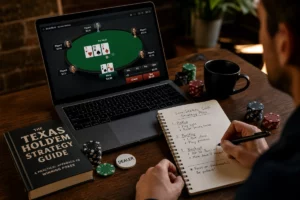


Why a balanced study routine beats endless hours at the tables
You probably know that playing a lot is important, but raw volume alone won’t create steady improvement. To move from guesses to +EV decisions, you need a deliberate blend of theory, targeted review, and applied practice. A balanced routine prevents tunnel vision, reduces tilt-driven habits, and accelerates learning by cycling concepts from thought to inspection to execution.
Think of your study routine like a training regimen: theory teaches technique, review corrects form, and practice builds muscle memory. When you separate these components and give each an explicit slot in your week, you stop repeating the same mistakes and start building reproducible winning processes.
Plan one weekly block: split time, set outcomes, and measure progress
Design your week around blocks rather than individual sessions. Blocks create rhythm and make it easier to track progress. For each block, define a clear outcome — not just “study poker,” but “understand 3-bet ranges vs. late-position open” or “reduce river calling errors by identifying weak-value lines.”
- Theory (25–35%): Learn concepts, ranges, frequencies, and solver outputs. Use short, focused lessons and take notes you can reference during reviews.
- Review (30–40%): Analyze your own hands and contrasting pro hands. Tag recurring leaks and build micro-goals to fix them in the next week.
- Practice (30–40%): Apply new concepts in volume sessions or focused drills (e.g., short-stack situations, preflop 3-bet responses).
Example weekly block (12–15 hours):
- 3 hours: core theory lessons and solver walkthroughs
- 4 hours: hand review with notes and leak tracking
- 5–8 hours: focused play sessions or simulator drills
How to rotate focus during daily sessions so learning sticks
Daily sessions should feel purposeful. Start with a short 20–30 minute warm-up reviewing yesterday’s key hand or a flashcard of ranges. Then split the session into two contrasting parts: one concentrated theory or review segment and one practice segment. This alternation helps you encode concepts and immediately test them in live decisions.
- Warm-up (10–15 min): quick range drills, mental checklist, or session objective.
- Theory/Review block (30–60 min): study a narrow topic or analyze 10–20 hands with a checklist.
- Practice block (60–120 min): apply the topic in real games or solvers, then log outcomes.
Keep measurable markers: hours studied, hands reviewed, and a simple performance metric (winrate proxy, mistake count, or A/B comparison of lines). Consistent, small feedback loops let you iterate faster than chasing generic improvement.
In the next section, you’ll get concrete session templates, drill examples, and tools to implement this weekly block so you can start practicing with purpose.

Concrete session templates you can start using today
Below are three ready-to-run templates you can drop into your week. Each one keeps the same warm-up → focused study → practice → review loop so learning moves from concept to habit.
-
Daily short session (2 hours)
- Warm-up (10 min): range flashcards or a quick mental checklist.
- Theory/Drill (30 min): one focused topic (e.g., 3-bet vs. late open). Read notes or run a 10–15 min solver check.
- Practice (60 min): play with an explicit objective (e.g., defend wider vs. 3-bets in position). Log hands and tag mistakes.
- Cooldown review (20 min): review 8–12 hands from the session, tag 2–3 leaks, set a micro-goal for next session.
-
Deep weekday study (4 hours)
- Warm-up (15 min): review last session’s micro-goal and one range chart.
- Theory block (60 min): solver walkthrough or concept video; take structured notes (problem → solver output → takeaway).
- Targeted drills (60 min): run 2 drills (e.g., flop SPR scenarios + river decision trees).
- Practice (75 min): focused play with pre-declared objective and HUD filters on.
- Hand review + logging (10 min): tag 15–25 hands and assign leak categories.
-
Weekend deep block (8–10 hours)
- Warm-up (30 min): long-range flashcards, mental-game routine.
- Theory deep-dive (120 min): study 2–3 solver spots or an in-depth ICM module if you play MTTs.
- Play block (180–240 min): extended session applying the concepts; aim for volume.
- Review (90 min): detailed solver checks on 5–8 key hands, update leak tracker, set weekly micro-goals.
- Weekly planning (30 min): update metrics, schedule next week’s block focus areas.
Practical drills and tools to accelerate specific leaks
Drills should be narrow and measurable. Below are high-impact drills matched to common leaks, plus tools and metrics so you can track real improvement.
- Range recognition (10–15 min daily): Use Anki or a range trainer with screenshots of board textures and ask “what does villain’s range look like?” Metric: % correct classification over a week.
- 3-bet defense drill (30–45 min): Pull 30 hands from your database where you faced a 3-bet. For each, decide a defense plan, then run 8–10 critical spots through your solver. Metric: frequency deviation from solver and EV delta on corrected lines.
- Flop SPR scenarios (45 min): Create 5 board textures at specific SPRs and solve for optimal c-bet/check ranges. Practice applying those ranges in play. Metric: c-bet success by board type + exploitability reduction.
- River thin value / bluffcatcher drill (20–30 min): Review 20 river decisions where you called/folded marginal hands. Use hand-history replays, then compare with solver suggestions. Metric: % of river errors and EV swing estimate.
- ICM and shorthanded push-fold (MTT players): Short drills with ICMIZER or HRC—practice final-table spots and late-stage shoves. Metric: % of correct shove/fold choices and chip EV improvement.
Recommended tools: PioSOLVER, GTO+, Simple Postflop, Flopzilla/Equilab, PokerTracker/Hold’em Manager, ICMIZER, Anki (for ranges), and a note system (Obsidian or Google Sheets). Build a small “leak tracker” spreadsheet with columns: leak type, frequency, session source, corrective drill, and next-review date. Aim to cycle 2–3 drills per week, always pairing correction with immediate practice, and re-test after one week and again after three weeks to lock gains via spaced repetition.

Putting the routine into motion
Start small, commit to the weekly block structure, and treat each session as an experiment: a clear hypothesis, a test, and an outcome. Prioritize consistency over intensity — short, high-quality study beats sporadic marathons. Use your leak tracker to force accountability, rotate drills to avoid plateaus, and schedule deliberate review points (one week and three weeks) to measure retention.
- Set one measurable micro-goal per week and a single performance metric to track it.
- Pair every corrective drill with an immediate practice session to cement the change.
- Use solver checks selectively: focus on recurring, high-impact spots rather than chasing every marginal line — tools like PioSOLVER are powerful when used with a clear question.
With a balanced mix of theory, review, and practice, the routine becomes a feedback loop that turns insights into habits. Keep the structure flexible enough to fit your schedule but strict enough to produce measurable improvement.
Frequently Asked Questions
How much time should I dedicate to study versus play each week?
A good starting split is 30% theory, 35% review, and 35% practice within a weekly block (12–15 hours as an example). Adjust based on where you leak most: beginners often need more theory, while experienced players benefit from more review and targeted practice.
Which tools are essential for implementing this routine?
Core tools include a solver or equity engine (PioSOLVER, GTO+, Simple Postflop), a hand tracker (PokerTracker/Hold’em Manager), range/board explorers (Flopzilla/Equilab), and a note system (Obsidian, Google Sheets). Use Anki or a range trainer for daily recognition drills.
What’s the simplest way to track and fix recurring leaks?
Keep a leak tracker spreadsheet with columns for leak type, frequency, session source, corrective drill, and next-review date. Tag hands during review, assign a corrective drill, retest after one week, and re-evaluate after three weeks to confirm improvement.