


How a disciplined daily study routine accelerates your poker improvement
You know that raw volume at the tables isn’t enough to climb stakes or fix leaks. A structured study routine turns practice into progress by targeting specific skills, eliminating guesswork, and creating repeatable habits. When you treat study like training—mixing review, theory, and deliberate practice—you convert hours into measurable edge.
This part covers the purpose of a daily routine and the core elements to include so your sessions stay focused and efficient. Later you’ll get a concrete sample plan you can plug into your week and adapt to your schedule.
Daily study framework: the elements to include and how to balance them
A balanced session blends four types of work: review, concept study, practical drills, and reflective tracking. Aim to rotate emphasis depending on whether you played that day and what leaks appeared. Below is a practical breakdown you can apply to sessions from 45 minutes to 2 hours.
Core components (what you should do each day)
- Session review (20–30% of time) — Quickly analyze hands you played that day. Focus on 5–10 hands that cost you the most EV or that you found confusing. Use a hand history viewer or database to tag problem spots.
- Concept study (30–40% of time) — Learn one specific theory item: ranges, bet sizing logic, polarized vs merged strategies, ICM, or multiway play. Read a short chapter, watch a focused video, or study solver output.
- Deliberate practice drills (20–30% of time) — Do active work like GTO trainer spots, push-fold exercises, preflop range quizzes, or live simulation against known exploitative lines. Make drills timed and measurable.
- Tracking and goal setting (10–20% of time) — Log results, update A/B tests (e.g., try different 3-bet sizing for a week), and set the specific adjustment for your next session.
Typical time-block examples you can adapt
- 45–60 minute session: 10 min review, 20–25 min concept study, 10–15 min drills, 5 min tracking.
- 90–120 minute session: 20–30 min review, 35–45 min concept study (include solver output), 25–35 min drills, 10 min tracking and goal update.
- When you didn’t play today: Shift more time to concept study and drills; still finish with tracking and a micro-review of sample hands from database work.
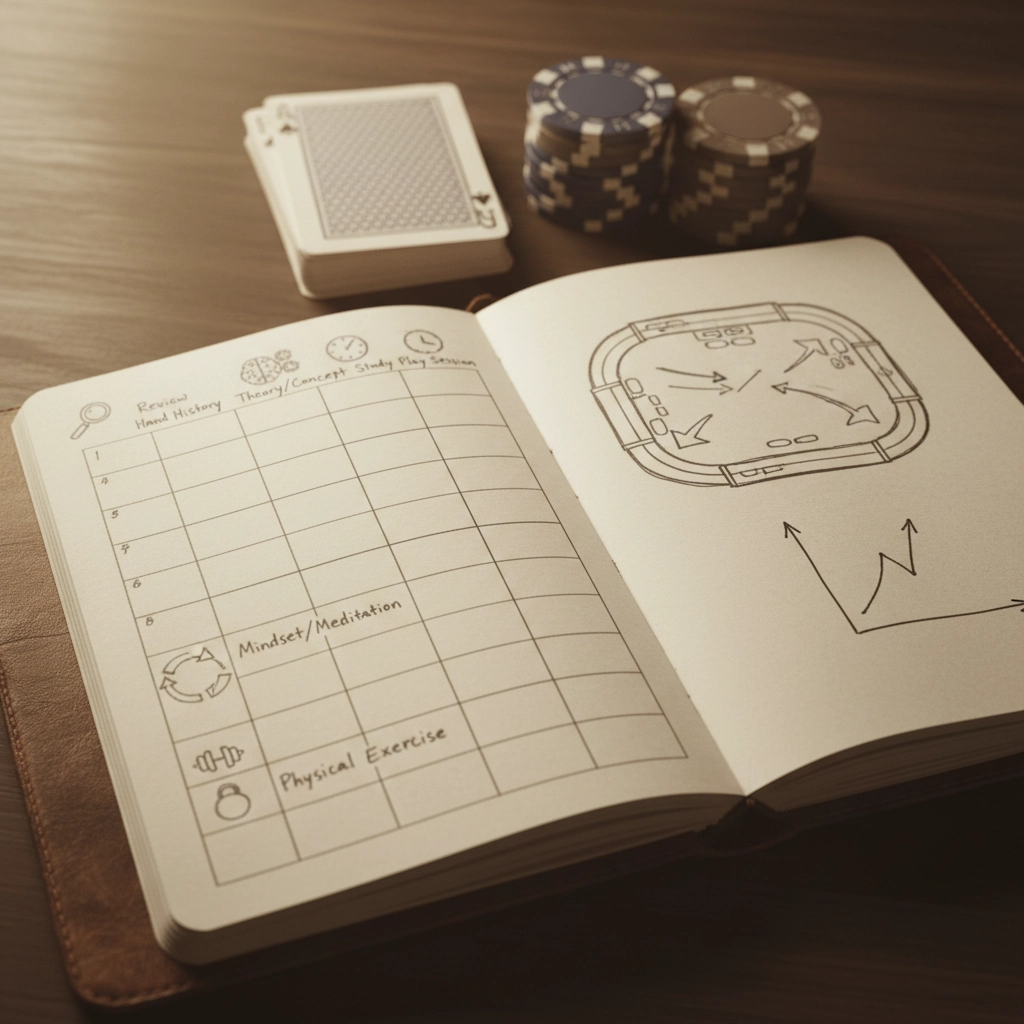
Use a simple habit tracker or spreadsheet to note what you studied, how long you spent, and one measurable takeaway to test in-game. Over weeks you’ll see patterns that tell you where to double down or rework fundamentals. In the next section you’ll get a ready-to-use 90-minute daily plan with specific drills, software tools, and example goal templates to implement immediately.

90-minute daily study plan: a plug-and-play template
This is a ready-to-run 90-minute routine you can drop into any training day. It follows the framework above but gives concrete drills, software, and sample goals so you don’t spend warmup time deciding what to do.
- 0:00–0:15 — Session review (15 min)
Open your session database (PokerTracker/Hold’em Manager) and filter the day’s hands. Pick 5 hands: the two biggest losers, two interesting spots you were unsure about, and one hand that looked standard but made you uncomfortable. For each hand note: villain type, stack sizes, what you think you should have done, and one concrete question to answer in the concept block.
- 0:15–0:45 — Focused concept study (30 min)
Pick a single, narrow concept tied to those review questions. Examples:
- 3-bet range construction and sizing vs BTN (use Flopzilla/Equilab to visualize how sizings change equity realization).
- Turn barreling frequencies by board texture (watch a 10–15 min video or read a short article, then examine solver output).
- ICM push/fold thresholds for final-table spots (use ICMIZER for tournament players).
Tool stack: GTO+ or PioSolver for one solver spot, Flopzilla for range work, or a training site video. Finish by writing one tactical rule you’ll test (e.g., “3-bet larger vs BTN open when CO is fishy; use 12–13bb sizing”).
- 0:45–1:05 — Deliberate practice drills (20 min)
Run two focused drills with measurable outputs:
- 10 rapid GTO trainer spots (GTOWizard/GTO+ trainer) — track % correct and time per spot.
- 5 timed push-fold situations or short-stack shove/fold trainer if in tournament mode.
Make drills timed: aim to improve speed and accuracy across sessions. Record baseline accuracy to compare next week.
- 1:05–1:20 — Application simulations (15 min)
Simulate the exact game context you’ll play next (cash vs MTT, table position, stack depths). Use hand replayer or solver to step through 3–4 realistic lines you flagged in review and apply the new rule. Note any deviations and why.
- 1:20–1:30 — Tracking and goal update (10 min)
Log what you did in your study spreadsheet: topic, tools, measurable result from drills, and one A/B test to run at the tables. Example goal: “This week test 3-bet sizing +1.5bb on BTN opens for +0.05bb/hand.” Add one reflection metric (mistake type frequency, exploitability from solver, or win-rate target).
How to adapt the template for short sessions and post-tournament days
Not every day allows 90 minutes. Here’s how to keep the same impact in smaller time frames and after long tournaments.
- 30–45 minute squeeze — Skip the application simulations. Review 3 hands (10 min), do a single focused concept (15–20 min), finish with one 5–10 minute drill and a one-line goal.
- After a long MTT deep-run — Rest first. Next day, do a low-cognitive micro-review: tag hands and prioritize mental-leak work (tilt triggers, ICM mistakes). Use shorter, low-intensity drills (push-fold trainer 10–15 min) and avoid heavy solver work until refreshed.
- Busy grind weeks — Turn one study block per week into a deep-solver day (90–120 min) and keep daily sessions to 30 minutes focused on concrete A/B tests and tracking.
These adaptations preserve the train-test-reflect loop while fitting real schedules. The next part will show sample goal templates and a weekly plan to scale this routine into long-term improvement.
Putting the plan into action
Make one small commitment today: block a recurring 90-minute slot or a 30-minute daily window and equip it with a single concept and one measurable drill. Consistency compounds—starting with a manageable habit and tracking it will reveal the highest-leverage areas to expand. If you use a session database, ensure it’s connected and tagged (PokerTracker is a common choice to automate this part) so you can move straight from play to focused review without friction: PokerTracker.
- Schedule the session and protect the time.
- Pick one concept to study and one drill to measure improvement.
- Log the result and set a single A/B test for the tables.
Frequently Asked Questions
How often should I change what I study?
Rotate your primary focus weekly or when your tracked metrics stop improving. Keep daily sessions narrowly focused (one concept, one drill) and switch emphasis when you’ve run a meaningful sample of hands or completed a measurable A/B test—usually 1–2 weeks per test for cash games, longer for low-volume tournament work.
What if I don’t have solver access or paid tools?
You can still run an effective routine using free tools and conceptual study. Use equity calculators like Equilab/Flopzilla alternatives, hand history reviews to identify patterns, free videos/articles for theory, and push-fold trainers or site-provided quizzes for drills. Track results manually in a simple spreadsheet and prioritize patterns you can exploit without solver precision.
How do I know the study routine is working?
Measure improvement with concrete, repeatable metrics: drill accuracy and speed, frequency of recurring mistakes in session reviews, and ultimately bankroll/ROI over an appropriate sample. Short-term signals (higher drill scores, fewer similar mistakes) validate study choices; long-term win-rate or ROI improvements confirm meaningful progress.