

Why a daily poker study plan accelerates your improvement
You can’t become a stronger poker player by playing alone or by reading random strategy articles. A daily, focused study plan turns vague intentions into measurable progress. When you assign specific topics to each day, you reduce cognitive friction, reinforce learning through repetition, and make it easier to track what actually improves your win rate. This approach works whether you’re a recreational reg or an aspiring grinder: consistent small improvements compound faster than occasional marathon sessions.
Use this plan to split technical learning, practical drills, review, and mental-game work into manageable chunks so you arrive at the table with clearer decisions and better instincts. Below are principles to shape a weekly framework, followed by the first three daily focuses you can implement immediately.
How to build a weekly framework that matches your schedule
Set realistic time blocks
Decide how many hours per week you can dedicate to study, then break that into daily blocks. A realistic starting point is 30–60 minutes on weekdays and 1–2 hours on weekends. Short, frequent sessions enhance retention better than infrequent long ones. Stick to the blocks like you would a training session—consistency matters more than intensity.
Pick complementary weekly themes
Organize topics so adjacent days reinforce each other. For example, pair preflop work with postflop follow-up, and alternate technical study with practical drills and hand review. Each day should have a clear outcome: what you will practice and how you will measure success (e.g., “I’ll reduce my cold-call frequency in spots X–Y” or “I’ll identify three leak patterns from my last 200 hands”).
Tools and methods to rotate through
- Solver output and range charts for technical study
- Hand-history review to apply concepts
- Drills: equity calculators, range-construction exercises, and spaced-repetition flashcards
- Mental-game work: routines, tilt control, and session planning
Monday–Wednesday: Focus on fundamentals and immediate application
Monday — Core fundamentals and GTO concepts
Start the week by refreshing essentials: pot odds, equity, stack-depth effects, and basic game theory. Use 30–60 minutes to study solver-approved lines for common spots and to review range-building principles. Finish with one short drill: practice recognizing pot-odds thresholds or assembling a basic 3-bet defense range for specific stack sizes.
Tuesday — Preflop ranges and exploit adjustments
Dedicate this day to preflop decisions: opening widths, 3-bet and 4-bet strategies, and effective stack-depth adjustments. Compare solver recommendations to what you actually play by examining recent hands. Spend part of your session constructing tight, loose, and polarized ranges for common positions, then run a quick spreadsheet or note to track adjustments you’ll test at the tables.
Wednesday — Postflop tactics and flop texture recognition
Mid-week is ideal for postflop study: c-bet frequencies, turn planning, and how flop textures change strategy. Work through examples where you choose a plan for the turn and river during your study, and then review hands where your plan went wrong. Practice classifying flops into broad categories so you can quickly select balanced or exploitative lines during live play.
With Monday through Wednesday set, you have a strong foundation of theory and practical drills to take to the tables; next, you’ll expand into mid-week and weekend focuses that emphasize review, simulation, and mental-game reinforcement.
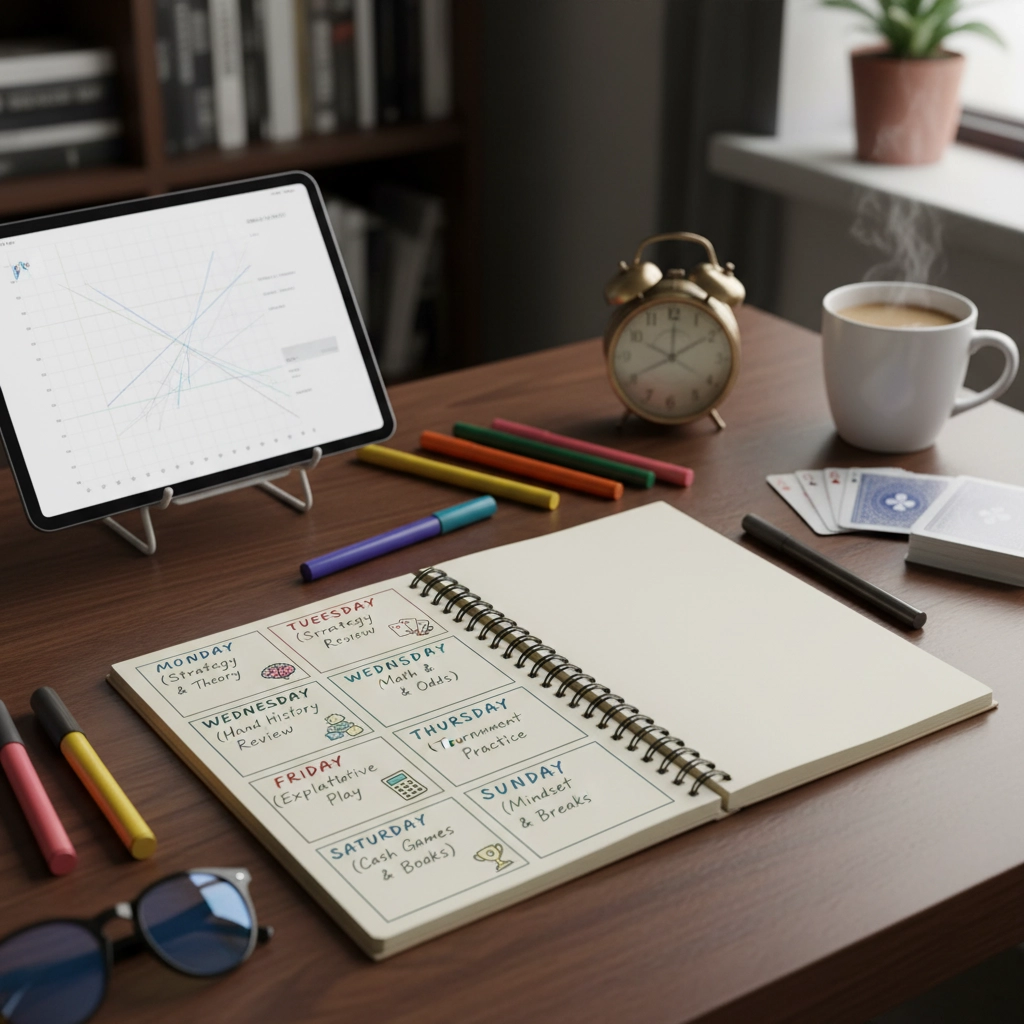
Thursday — Focused hand review and leak plugging
Thursday is the day to slow down and inspect what you actually did wrong (and right). Instead of skimming a handful of hands, set aside 60–90 minutes for a structured review of a defined sample: the last 200–500 hands or an entire session where you felt uncomfortable. The goal is to turn vague frustrations into specific, fixable leaks.
How to run the session:
– Filter: Use your HUD/hand-history manager to pull hands by spot (e.g., late-position 3-bets, defending the big blind vs. steal, river-call shoves). Narrowing the view helps isolate patterns.
– Rotate lenses: For each hand, ask three questions — (1) What was my decision process? (2) What range did I put my opponent on? (3) Does solver or equity analysis support my line? Spend extra time on repeated mistakes rather than rare cooler spots.
– Document: Log one actionable fix per leak (e.g., “fold more to CBets on dry A-high boards from CO vs BB” or “tighten cold-call range from BTN from 22% -> 18% facing 3.5x open”).
Drills and measurement:
– Pick 2 recurring leaks, create a short drill (e.g., reload 50 BTN vs SB steal hands and force yourself to fold X% more), and track results next week.
– Use a checklist to classify each reviewed hand (Good call/Bad call/Standard mistake/Unclear), and aim to reduce “standard mistakes” by 50% over four weeks.
Friday — Simulation drills, ICM, and final-table decisions
Use Friday for simulation work that’s hard to replicate at a regular cash-table session: multi-way pots, deep-stacked scenarios, and tournament-specific decisions under ICM pressure. Blocks of 45–90 minutes work best.
What to practice:
– ICM and bubble play: Run a few concrete tournament spots through an ICM calculator or solver. Practice deciding when to open shove, call, or fold in short-stack and medium-stack dynamics.
– Multiway and deep-stack flow: Use equity calculators and run hand ranges for multiway pots where SPR and blocker effects drive different lines.
– River decision trees: Pick 10 hands from your pool and build full decision trees (range vs range) to see where exploitative adjustments are warranted.
Outcomes and drills:
– Simulate 20 short-stack shove/fold scenarios and log which stack-size thresholds you adjust for. Measure confidence by whether your answers match solver output for at least 70% of spots (if you use a solver) or align with expected ICM EV.
– For MTT-focused players, finish with one quick review of payout-sensitivity and how it changes push/fold ranges near bubbles and final tables.

Weekend — Volume sessions, long-form review, and the mental game
Use Saturday and Sunday for longer, integrative work: play the biggest sessions you can handle, then follow with a deep review and mental-game training. Plan 1.5–3 hours for study plus your session volume.
Session planning:
– Pre-session checklist: table selection, target stakes, intended exploitative adjustments, and one explicit rim-rule (e.g., “no splashy bluffs after losing big pot”).
– Post-session: immediately tag hands worth deep review and note emotional state during any leak incidents.
Mental-game reinforcement:
– Build a short routine (10 minutes) for pre- and post-session mental prep: breathing, goal setting (process metrics, not just wins), and a tilt-reset plan.
– Weekend drill: simulate a long-session endurance test—play two back-to-back shorter sessions and practice keeping decisions consistent. Track how your error rate changes in hour 1 vs hour 3 to pinpoint stamina issues.
By assigning review, simulation, and mental resilience to the latter part of the week, you’ll close the loop on theory learned earlier and arrive at the next week sharper and more intentional.
Before you start, commit to one simple experiment: follow this weekly rotation for four weeks and log one measurable change each week (a reduced leak, a new preflop habit, or improved tilt control). Adjust time blocks to match your life, keep the sessions focused, and treat the plan as a living document—tweak days and drills as you discover what moves your win rate and decision quality most.
Make it a habit, not a chore
Improvement in poker comes from consistent, targeted effort, not from occasional deep dives. Pick a realistic cadence you can sustain, protect those study blocks, and iterate on the plan based on results. If you want structured solver instruction or guided drills, check out advanced solver guides and training courses that match your stakes. Small, steady progress compounds—stay curious, track outcomes, and let the weekly routine carry you forward.
Frequently Asked Questions
How much daily time should I realistically commit to this plan?
Start with 30–60 minutes on weekdays and 1–2 hours on weekends, as suggested in the article. If that feels like too much, cut weekday blocks to 15–30 minutes and keep one longer weekend session. Consistency matters more than total hours.
Do I need a solver every day to follow this plan effectively?
No. Solvers are valuable for understanding GTO concepts and verifying lines, but you can alternate solver study with practical drills, hand review, and equity work. Use a solver selectively—once or twice a week for key spots—if you’re paying for one.
How do I avoid burnout from combining study and large-volume play on weekends?
Build a simple mental-game routine: set process goals, schedule short breaks during long sessions, and use the post-session checklist to limit how long you dwell on mistakes. Reduce study intensity after high-volume days—focus on tagging hands and a brief review instead of deep analysis immediately.