


How a Daily Routine Accelerates Your Poker Improvement
You know that consistent practice separates casual players from winners. A deliberate daily study routine trains both the theoretical backbone of Game Theory Optimal (GTO) play and the practical instincts needed to exploit common opponent mistakes. By splitting your study time between solver-based GTO work and exploitative, opponent-focused review, you build an adaptable game rather than a brittle strategy that collapses under pressure.
This routine assumes you play regularly and have access to hand histories and at least one solver or range-analysis tool. Even if you don’t use expensive software, the habits described—structured review, targeted drills, and goal tracking—will make every session more productive.
Daily Focus Areas: What You Should Work On Each Day
Structure your session so you touch on three core pillars: theoretical study, applied review, and mental/skill drills. Rotate emphasis across days to avoid burnout and deepen understanding.
- GTO foundations (30–45 minutes): Run solver scenarios or study precomputed ranges for common spots—3-bet pots, open-raising ranges, and river decision trees. Focus on understanding range construction and indifference points rather than memorizing exact lines.
- Exploitative hand review (30–60 minutes): Go through recent hands with a critical eye: identify deviations from equilibrium that opponents make and note how you can adjust sizings, bluff frequencies, or calling ranges to exploit them.
- Practical drills (20–30 minutes): Use targeted exercises—range vs. range quizzes, equity calculations, and reporting drills where you summarize why you made specific plays. Repetition builds intuition.
- Session notes and goals (10–15 minutes): Log key takeaways, persistent leaks, and one concrete improvement goal for your next session. Track progress weekly.
Within each focus area, aim for quality over quantity. For GTO work, pick one spot and explore it deeply: run a solver with a few different stack depths and bet sizes, then translate solver recommendations into actionable rules you can apply at the table. For exploitative study, tag hands by exploitable tendencies (e.g., “calls too wide on the flop”) and create a short checklist of countermeasures.
Tools, Metrics, and Simple Routines to Keep You Honest
Use what’s available: hand history software to filter significant hands, a tracker for long-term stats, and a solver or equity calculator for spot checks. Track a few high-value metrics—fold-to-turn-bet, river bluff-catcher frequency, and 3-bet profitability—to measure whether your adjustments are working.
- Create a weekly rotation: one day heavy on solver study, one on multi-table hand review, and one focused on live/mental game application.
- Keep a short template for session notes: date, stakes, key hands, leaks found, adjustments tried, and one measurable goal.
- Limit passive, unfocused reviewing—set timers for each block and evaluate your note at the end of the week.
With these foundations in place you’ll streamline your improvement and ensure both GTO thinking and exploitative awareness grow in tandem. Next, we’ll walk through a practical, hour-by-hour daily schedule you can follow to implement this balance effectively.
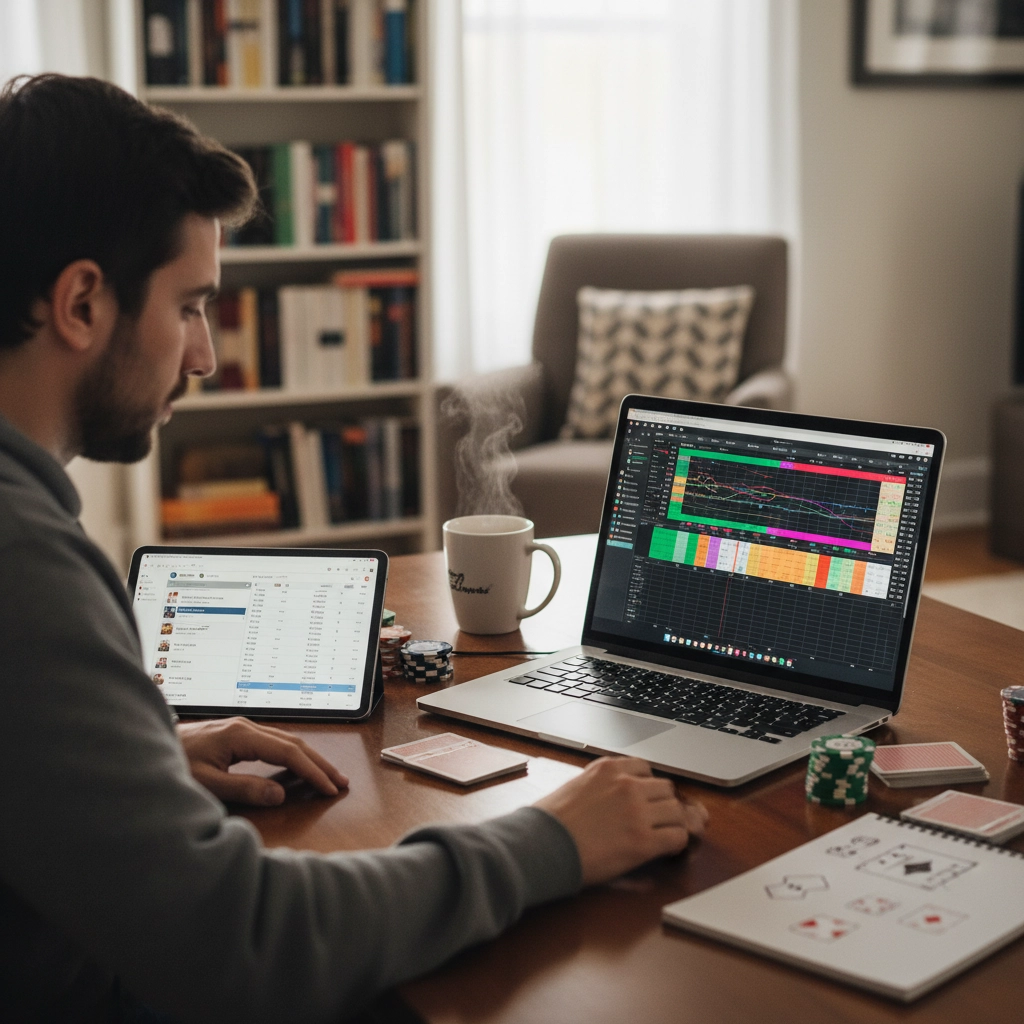
An actionable hour-by-hour daily schedule
Below is a template you can adapt to your available time. The goal is to force a balance between GTO depth and exploitative application while leaving room for drills and reflection.
– 60-minute session (tight days)
– 0:00–0:10 — Warm-up: review yesterday’s short notes and one persistent leak. Set a single improvement goal.
– 0:10–0:35 — Exploitative review: filter 8–12 recent hands for spots where opponents deviated from equilibrium (overfolding, calling too wide, over-cbetting). Pick one exploitable adjustment to test next time you play.
– 0:35–0:55 — GTO micro-drill: run a pre-set solver scenario (e.g., 3-bet pot vs. cold-call on a specific flop) and extract 2–3 actionable rules.
– 0:55–1:00 — Log: write the one change you’ll apply and which metric you’ll check.
– 120-minute session (ideal daily block)
– 0:00–0:10 — Warm-up + goal setting (as above).
– 0:10–0:45 — Deep GTO block: run multiple solver iterations with different bet sizes/stack depths. Note indifference points and common frequencies.
– 0:45–1:15 — Exploitative hand review: tag hands, summarize opponents’ tendencies, and draft countermeasures (adjust ranges, change sizing, alter bluff frequency).
– 1:15–1:35 — Practical drills: range vs. range quizzes, equity spots, or timed river-decision quizzes.
– 1:35–1:55 — Simulated implementation: mentally run through how you’ll apply the day’s rules in live play (table talk through 3–4 sequences).
– 1:55–2:00 — Session notes and one measurable test for your next session.
– 3+ hour session (weekly deep day)
– Use the 2-hour plan, then add a 45–90 minute block for extended solver exploration of a single complex spot and a 30-minute peer review or forum posting to get feedback.
Treat these templates as guidelines—stick to the timers to avoid rabbit holes and ensure you rotate focus across days.
Translating solver output into table-friendly rules
Solvers give precise mixes and frequencies that are impossible to replicate verbatim at the table. Your job is to extract robust heuristics you can apply under pressure.
– Convert percentages into qualitative rules: “bet 2/3 of the time” becomes “lead more often on dry boards” or “check back thin value hands less frequently against aggressive opponents.”
– Create simple decision trees: instead of memorizing thousands of combos, map out 3–4 branch points (board texture, villain type, stack depth) and a default action for each.
– Make sizing rules of thumb: if the solver prefers smaller sizing with high-frequency bluffs on certain textures, note “use small c-bet vs. calling ranges; use larger bets when you expect folds.”
– Practice application in drills: run through hands imagining you have the solver’s distribution, then pick the rule you’d use. Repeat until the rule becomes intuitive.
– Keep an “if–then” cheat sheet in your notes (e.g., “If opponent overfolds to turn donks → increase bluff frequency on turn when checked to”).

Common study pitfalls and how to course-correct
Even disciplined routines can derail. Watch for these traps and apply simple fixes:
– Analysis paralysis: limit time on any one spot and force a rule extraction at the end of each solver run.
– Overreliance on solvers: always test solver-derived rules against real hands—if a rule consistently loses in practice, reassess assumptions about opponent ranges.
– Cherry-picked hands: ensure your exploitative review samples broadly; use filters for common opponent tendencies, not just interesting hands.
– Lack of implementation: commit to one change per play session and measure it with a single metric that you track.
– Stale repetition: rotate study formats (video, solver, peer review, live practice) to keep learning active.
By scheduling focused blocks, translating solver math into portable rules, and watching for common study errors, your daily routine will produce practical, table-ready improvements rather than theory that lives only on your hard drive.
Putting the routine into action
Daily study is a habit, not a sprint. Pick one small, measurable change you can test this week, time-box your study blocks, and treat the solver as a teacher rather than a bible. Keep your notes simple, stay curious about opponent patterns, and iterate: adjust one thing, measure it, and refine. If you want guided walkthroughs on using solvers and translating output into practical rules, check resources like Upswing Poker for tutorials and drills to accelerate the process.
- Commit to one clear test per play session.
- Limit solver runs to actionable rule extraction—no analysis paralysis.
- Review results weekly and adapt the next week’s focus accordingly.
Frequently Asked Questions
How much daily time do I really need to improve?
Quality beats quantity. Even a focused 60-minute session with a clear goal (one solver spot, a short exploitative review, and a drill) will produce steady gains. Aim for consistency—five compact, targeted sessions a week is better than one long, unfocused marathon.
What if I don’t have access to a solver—can I still follow this routine?
Yes. Replace solver blocks with structured range study, equity calculations using free tools, and scenario-based thought exercises. Use hand history review and opponent tagging to build exploitative adjustments. As you progress, consider investing in solver access or study resources.
How do I prevent analysis paralysis when studying with solvers?
Set strict time limits per spot, force a one- or two-line actionable rule at the end of each run, and track only one metric while testing changes. If a spot consumes too much time, shelve it for a deep day and move on to maintain momentum.