
Build a Daily Poker Training Routine That Produces Results
You want steady improvement, not occasional breakthroughs. A routine turns effort into measurable progress by forcing consistent exposure to theory, deliberate review of your own decisions, and frequent real-table practice. Treat your poker training like any high-performance skill: you plan sessions, set small goals, measure outcomes, and iterate. This section shows how to create a foundation so every hour you spend trains the right habits.
Why a routine beats random study
Random study sessions leave gaps: you over-focus on spots you enjoy and ignore recurring leaks. With a routine, you distribute attention across fundamentals (hands and ranges), situational play (short-handed, blind defense, ICM), and emotional/mental skills (tilt management, focus). Building a weekly rhythm prevents stagnation and creates a feedback loop where review informs study and table play validates learning.
Structure your study, review, and play blocks
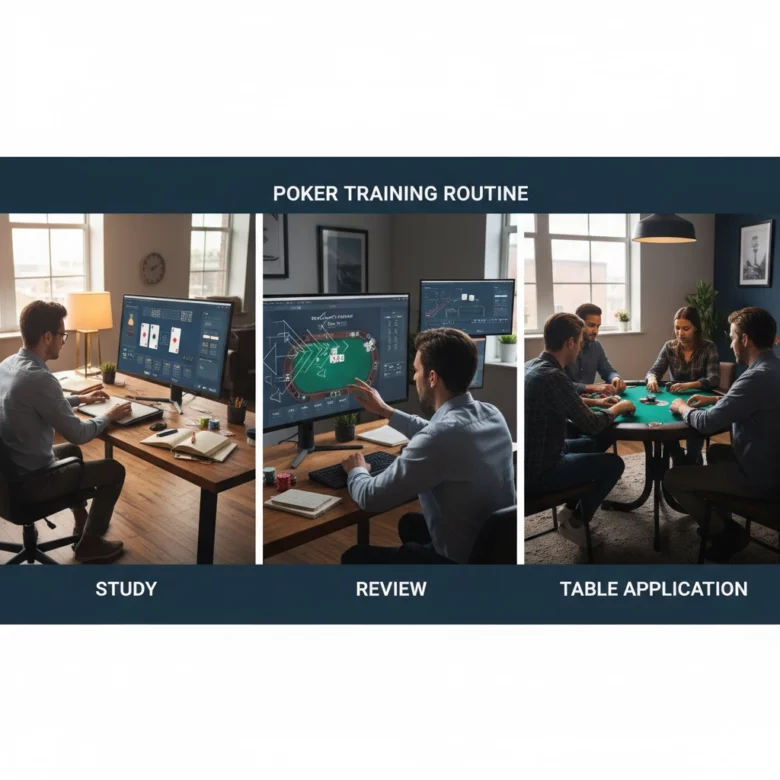
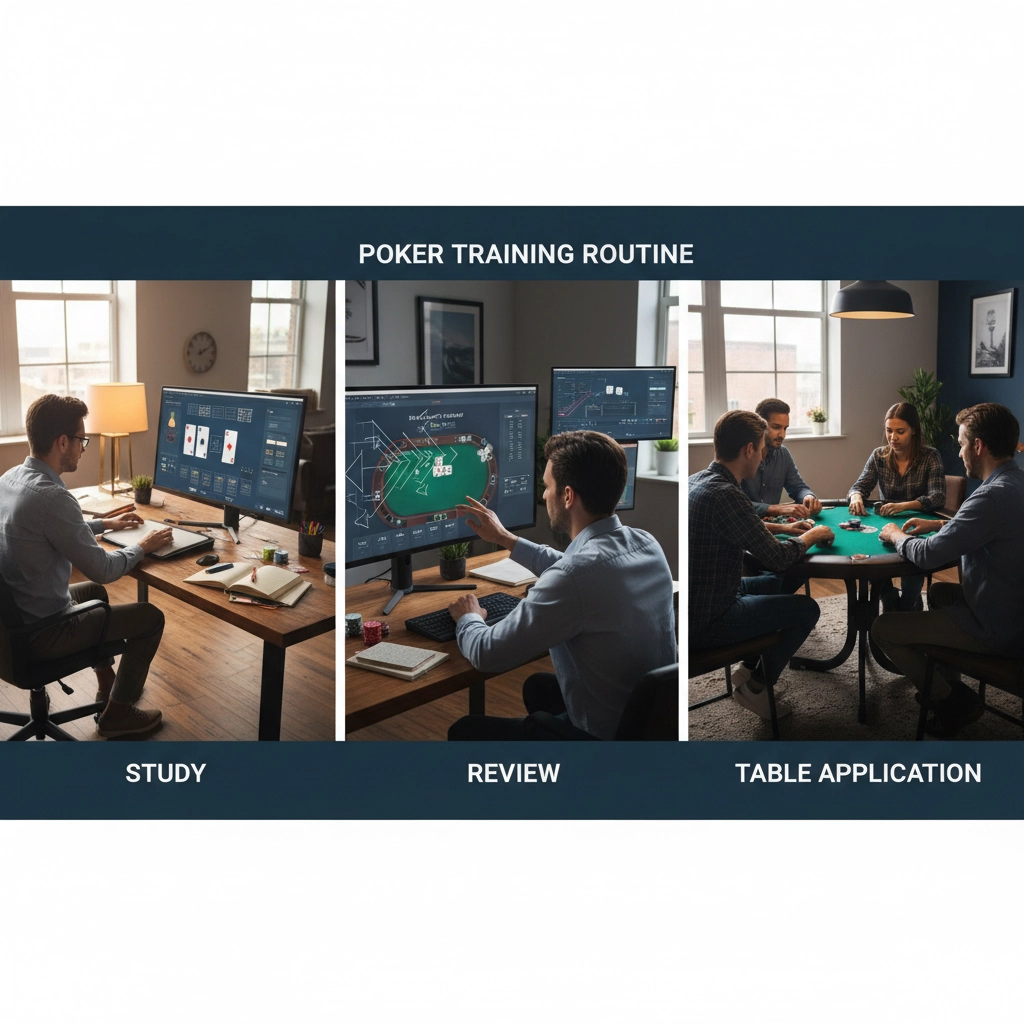
Divide your time into focused blocks: theory study, hand review, and live/table application. Keep blocks short and purposeful—45–90 minutes is ideal for deep focus—then switch context. Below is a practical weekly split you can adapt to your schedule.
Example weekly split and session types
- Theory study (30–40% of training time): Watch concept videos, read articles, work through solver outputs, and practice range construction. Focus on one topic per session (e.g., c-betting frequency, 3-bet bluff strategy) and write down 2–3 actionable takeaways to test at the tables.
- Hand review (20–30%): Analyze your recent sessions with a HUD, tracker, or hand histories. Prioritize hands that lost you significant EV or repeated mistakes. For each hand, pinpoint the decision, the ranges involved, and one specific change you’ll implement next time.
- Table application (30–40%): Play with intentions. Enter each session with a micro-goal (e.g., “defend more accurately from the big blind” or “open a tighter 3-betting range”). After each session, mark whether you achieved the goal and what prevented you from doing so.
- Mental skills and review notes (10%): Spend brief time on tilt control, focus routines, and reviewing your notes. This keeps psychological leaks from erasing technical gains.
Daily micro-routine you can follow
- Warm-up (10 minutes): review one key concept or a short solver solution.
- Primary study block (45–60 minutes): deep work on the week’s chosen topic.
- Short play session or drills (30–90 minutes): apply learnings; use focused goals.
- Quick review (15 minutes): log mistakes and ideas for next study block.
Design your routine around your available time and energy. What matters most is consistency and the loop: study → apply → review. In the next section, you’ll learn specific methods and tools to analyze hands deeply and convert hand-history review into concrete adjustments at the table.

Tools and methods for deep hand analysis
To turn a handful of confusing hands into lasting improvements you need the right tools and a repeatable method. The toolset is straightforward: a hand database and HUD (PokerTracker, Hold’em Manager), a solver (PioSOLVER, GTO+, Simple Postflop), an equity calculator (Equilab, Flopzilla), and a note/knowledge system (Notion, Excel, or even a plain text file). Use each tool for its strength and follow a consistent workflow:
– Select and prioritize hands. Filter your database for big losers, repeated leak spots (3-bet pots, blind vs blind, multiway pots), or hands that make you uncertain. Limit yourself to 5–10 hands per review to maintain depth over breadth.
– Reconstruct the hand. Recreate stack sizes, effective stacks, table dynamics, and opponent types. Solvers are sensitive to ranges and bet sizing, so be precise.
– Range construction and equity checks. Build realistic ranges in your solver or Equilab. Start with a GTO/neutral baseline then layer in exploitative adjustments (tighten vs TAGs, widen vs maniacs). Run equity sims to see where your bluffs or calls lose equity and where they get value.
– Run solver lines selectively. Don’t try to solve full-gametrees initially—focus on the street and sizings that mattered. Compare your line to the solver recommendation, note frequency differences (e.g., solver c-bets 35% but you did 60%) and expected value delta.
– Translate findings into rules. For each hand, write one clear, testable change: a frequency (c-bet 35% on J-high boards), a range tweak (fold more small pairs on 3-bet pots), or a strategic posture (play deeper postflop vs stations). Put these into your training notes.
Caveats: solvers give a theoretically optimal baseline, not a one-size-fits-all solution against human opponents. Prioritize high-leverage adjustments (those that address frequent spots or big EV swings) instead of chasing perfect lines in rare scenarios.
Turn hand review into controlled table experiments
Study without disciplined testing is wasted time. Treat each change from your review like a hypothesis and test it at the tables.
– Define the hypothesis and metric. Example: “If I reduce c-bet frequency to 40% on dry ace-high boards, my win-rate in those spots will increase by X or my fold equity will rise.” Choose measurable metrics: fold-to-c-bet, win-rate in that spot, opponent call frequency, or straightforward EV estimates from your solver.
– Limit variables and time. Test one change at a time. Run your experiment for a fixed sample—either a number of hands (e.g., 500 relevant opportunities) or a time period (two weeks). This avoids confounding factors.
– Pre-session intentions and live notes. Start sessions with a micro-goal tied to the experiment. During play, tag hands that fit the test and add short notes (opponent type, outcome, deviation). Use HUD popups or session tags to mark tracked hands automatically.
– Review outcomes and adapt. At the end of the test period, review the tagged hands: did the metric move? Were there unanticipated effects (more floaters catching you, different types of opponents exploiting the change)? If results align with the hypothesis, adopt the change; if not, either revert or refine the rule and run a new test.
Keep your experiments small and iterative. Rapid cycles of hypothesis → test → review are how solid, opponent-specific strategies emerge. And remember: stick to process metrics (frequencies, EV in specific spots) rather than short-term bankroll swings—variance will otherwise derail good learning.

Prevent analysis paralysis: focus on high-leverage leaks
It’s easy to drown in hands, solver outputs, and “what-if” scenarios. Avoid that by ranking issues by frequency and EV impact. Start with the biggest recurring leaks — opening ranges, blind defense, river decision-making — and only then move to niche situations. Set a weekly cap on review time and commit the rest to deliberate play. Constrain your work to actionable changes you can realistically test at the tables. This keeps learning efficient and your routine sustainable.
Putting the Routine Into Motion
Now that you have the pieces — structured study, disciplined hand review, controlled experiments, and a focus on high-leverage leaks — the next step is simple: start. Set one small weekly goal, commit to the micro-routine for seven days, and treat the first cycle as a baseline rather than a verdict. Track a single process metric for that week and let the data guide your next adjustment.
Expect friction early: changing habits and resisting easy but suboptimal plays takes time. When you feel stuck, return to the smallest version of the routine that still produces learning: one focused study block, one short session with an explicit micro-goal, and a five-hand review at the end. Repeat, measure, and iterate.
If you use solvers for study, a tool like PioSOLVER can help you form a theoretical baseline to compare against your practical results. Above all, keep the loop tight — study → apply → review — and let consistent, modest improvements compound into real win-rate gains over time.
Frequently Asked Questions
How long until I see improvement from a structured routine?
Improvement timelines vary by starting level and effort, but you should expect measurable changes in decision-making within 2–6 weeks if you train consistently (several focused sessions per week) and track process metrics. Meaningful win-rate changes can take longer due to variance; prioritize consistent practice and short iterative experiments.
How should I balance GTO solver study with exploitative adjustments?
Use solvers to build a GTO baseline and understand frequency-based concepts (c-bet rates, ranges, bet sizing). Layer exploitative adjustments only after you’ve identified opponent tendencies through HUD/data. Make small, testable deviations from GTO in controlled experiments and track outcomes to ensure they increase EV against your player pool.
What’s the best way to prevent analysis paralysis when reviewing hands?
Limit review time, prioritize high-frequency/high-EV leak spots, and cap the number of hands per session (5–10). Turn each reviewed hand into one specific, testable change and run a focused experiment rather than trying to fix everything at once. This keeps learning actionable and sustainable.