
Why Online Poker Still Has Tells — Just Different Ones
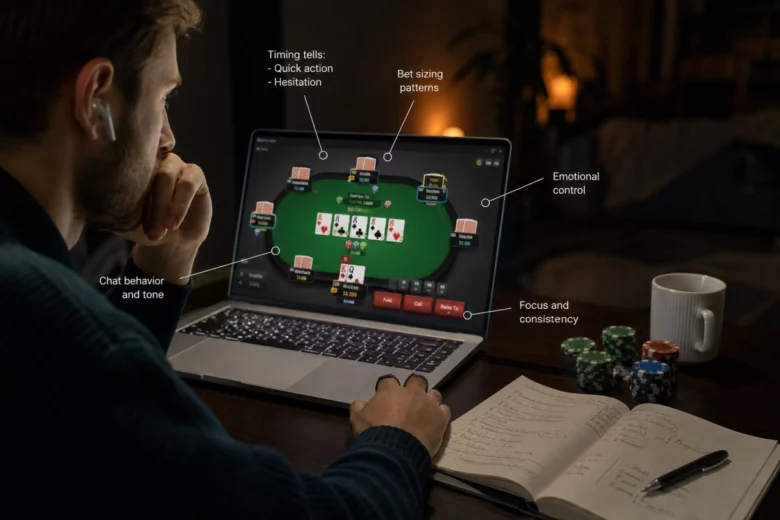
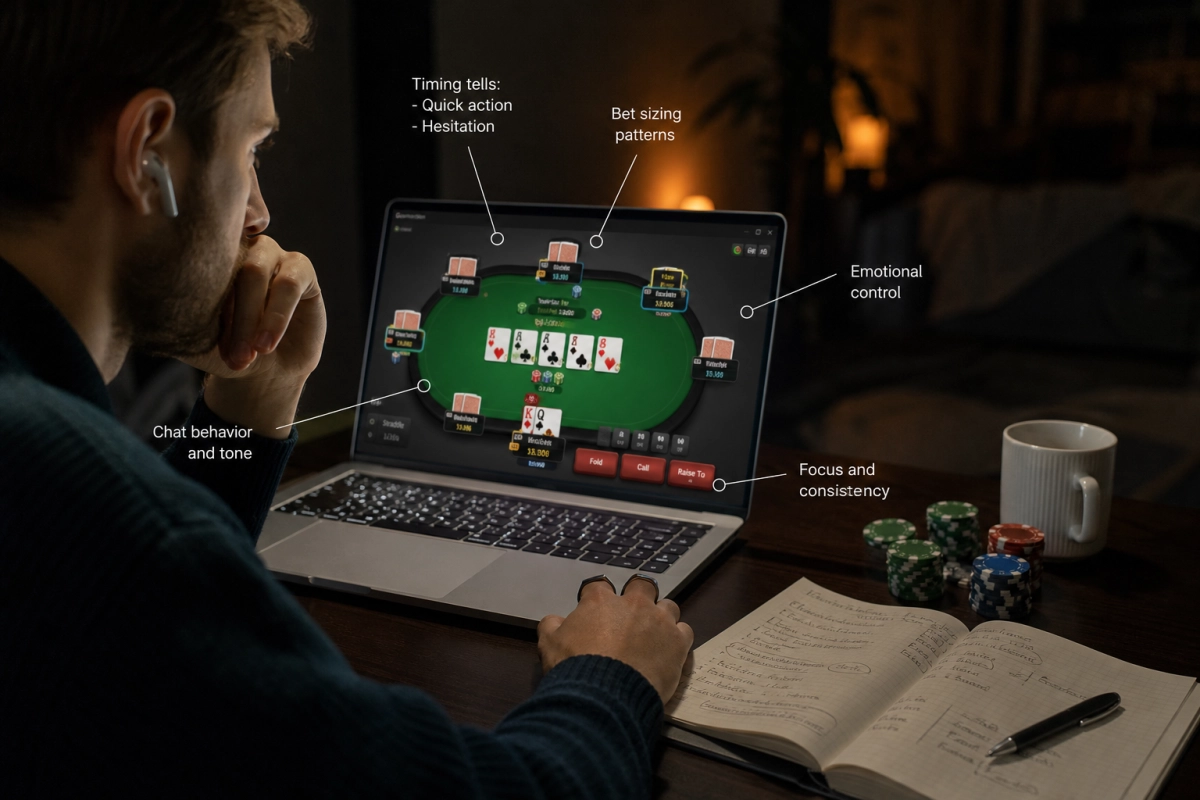
Most players associate poker tells with live games — a nervous glance, a shaking hand, the way someone stacks their chips. Strip those away and online poker might seem like a purely mathematical exercise where opponents are invisible. That assumption is worth challenging. Reading tells online is genuinely possible, but it requires shifting attention from physical behavior to digital behavior. The information is still there. It just arrives through different channels.
Online platforms record and display several observable data points during every hand: how long a player takes to act, whether they use auto-action buttons, how their bet sizing fluctuates, and how their patterns change as a session progresses. None of these signals are infallible, and none should be read in isolation. But when consistent patterns emerge across multiple hands, they offer meaningful insight into how an opponent is likely to think and act.
Timing Tells: What Response Speed Actually Communicates
Timing is the most accessible tell in online poker, and also one of the most misread. Speed does carry information, but context matters before drawing any conclusion. A fast action on the river means something very different depending on whether that player has been consistently quick all session or whether it followed an unusually long pause on the previous street.
Very fast actions often indicate one of two things: a decision requiring no deliberation, or a pre-selected auto-action. A snap-call of a large bet suggests the player had already committed mentally — implying either a strong hand or a stubborn call they never intended to reconsider. Snap-raises on later streets can signal a hand strong enough that no alternatives needed weighing. However, experienced players sometimes use deliberate speed to simulate decisiveness, which is why timing tells are most reliable when they deviate from an individual’s established baseline.
Longer pauses tell a different story. A player who tanks before calling a large river bet may genuinely be uncertain, or may be holding a strong hand and performing hesitation to discourage a raise. The key distinction often lies in what follows the pause. A long think before a minimum raise behaves differently from a long think before a fold, and tracking these outcomes over time builds a more accurate read.
Auto-Action Buttons and What They Reveal
Pre-action buttons allow players to queue decisions before their turn arrives. When used, the resulting action appears almost instantaneously — often distinguishable from a naturally fast manual response — and it reveals that the player had already decided before seeing what their opponent would do.
A pre-queued check or call can suggest passivity or a hand the player wants to continue with cheaply. A pre-queued raise is more telling — it implies confidence that didn’t require seeing the opponent’s action first. A player who consistently acts within one second on every street likely isn’t deliberating at all, which itself says something about their approach. Conversely, a player who is usually measured but suddenly acts with unusual speed on a particular street has broken their own rhythm — and that deviation is where the real tell begins.
Bet Sizing as a Behavioral Signature
Bet sizing patterns can reveal just as much as timing — sometimes more. Unlike live poker, online environments display exact figures instantly and store them in hand histories. This precision is an advantage for any player willing to pay attention.
The most useful starting point is establishing what counts as normal sizing for a given opponent. Some players default to rigid percentages — always half-pot on the flop, two-thirds on the turn. When a player operates mechanically, deviations carry extra weight. A sudden overbet from a player who has never exceeded three-quarters pot is a meaningful signal. It may indicate unusual strength or a bluff that required more pressure than their standard line could provide.
Recreational players tend to size bets in ways that correlate loosely but consistently with hand strength. Larger bets often accompany stronger holdings because the instinct to extract value overrides strategic awareness. Smaller bets on boards that should demand protection can suggest uncertainty or a draw looking for a cheap card. Neither pattern is universal, but treated as a starting hypothesis to test rather than assume, they give structure to observation.
How Sizing Patterns Shift Across Streets
Sizing tells become richer when tracked across a full hand rather than at a single decision point. A player who bets small on the flop and turn, then fires an oversized river bet, is telling a story worth interrogating. That late overbet can reflect either a hand that improved dramatically or a bluff designed to compensate for the weakness of the earlier lines.
Conversely, a player who sizes up incrementally across each street is more likely building value from a hand they were confident in from the start. This escalating pattern tends to be less deceptive among recreational players, who rarely plan three streets ahead with a bluff — making it a reasonable working assumption at most stake levels.
Session-Length Patterns and the Psychology of Fatigue
How player behavior shifts over the course of a session receives surprisingly little attention. The rhythms of a player’s decision-making during the first thirty minutes often look noticeably different from those in hour three or four. These shifts reflect the psychological demands of sustained attention and create patterns that attentive opponents can use.
Early in a session, many players operate with more discipline. They follow ranges carefully, take time on marginal decisions, and maintain consistent sizing. As a session extends — particularly after poor results — a different mode can emerge. Actions arrive faster. Bet sizes become less calibrated. The behavioral gap between strong and weak holdings narrows as frustration or fatigue overrides strategic thinking.
This state is commonly called tilt, but it manifests along a spectrum. Not every fatigued player erupts into aggression. Some become passive and call-heavy. Others tighten dramatically and only engage with premium hands. Recognizing which direction a specific opponent drifts requires tracking their behavior across the session — noting how timing, sizing, and frequency of play evolve over time.
Identifying Tilt Through Pattern Disruption
The clearest signal that an opponent’s mental state has shifted is consistency breaking down across multiple dimensions simultaneously. Individual deviations happen for specific reasons; clustered deviations usually indicate something broader. Watch for:
- Unusually rapid decisions on hands that previously prompted deliberation
- Bet sizing that inflates without clear board-texture justification
- Increased continuation bet frequency on boards that previously prompted checks
- Shorter gaps between folding one hand and posting the next — suggesting reduced patience
When two or three of these appear together over a concentrated stretch of hands, adjusting to exploit that opponent’s altered state becomes a well-grounded decision. The advantage of online play is that these patterns are all observable through the interface itself, without needing to interpret a facial expression across a felt table.
Positional Patterns and Table Dynamics
Before drawing conclusions from any single observation, consider positional context. A player who acts with unhesitating speed when last to act after everyone checks is responding to an easy situation. The same speed from early position, into active opponents on a coordinated board, is a different matter entirely.
Positional consistency is itself a tell. A player who only applies pressure from late position and becomes passive out of position is communicating something about their comfort level and likely their range. A player who bets with equal frequency from every position regardless of board texture is either highly experienced or operating without positional awareness — and distinguishing between the two typically requires watching how they handle a raise.
Table dynamics layer over all of this. In a session where one opponent has been running over the table, a sudden call from a historically passive player carries more weight than usual. They may have decided to make a stand — or may be overadjusting emotionally. Neither read is certain, but both are grounded in observable context rather than speculation.
Building a Read Over Time, Not a Single Hand
Every principle in this article shares a common thread: single observations are unreliable, but patterns accumulated across time and volume become genuinely useful. The player who bet three-quarters pot on the river once might have had any number of reasons. The player who does it consistently with top pair or better — and checks or bets smaller with everything else — has shown you something you can use.
This discipline separates players who casually notice behavior from those who profit from it. Noticing is easy. Cataloguing, cross-referencing, and adjusting based on consistent signals rather than convenient ones is harder, and it requires resisting the temptation to act on incomplete information simply because a hand presents itself at the right moment.
The absence of physical tells in online poker is real, but it has always been overstated as a limitation. What online play removes in one dimension, it compensates for in another — every action is timestamped, every bet size is exact, every session has a visible arc, and every deviation from a player’s baseline is observable without the noise of a crowded live table. The interface itself is the medium through which tells travel, and learning to read it fluently is one of the more durable skills a serious online player can develop.
Pattern recognition of this kind does not produce certainty — no read in poker ever does. What it produces is a steadily improving calibration: a clearer picture of which opponents are predictable, which are capable of deception, and which are operating on instinct rather than intention. That calibration, built hand by hand and refined across many sessions, is what makes behavioral awareness a genuine edge rather than a theoretical one.