

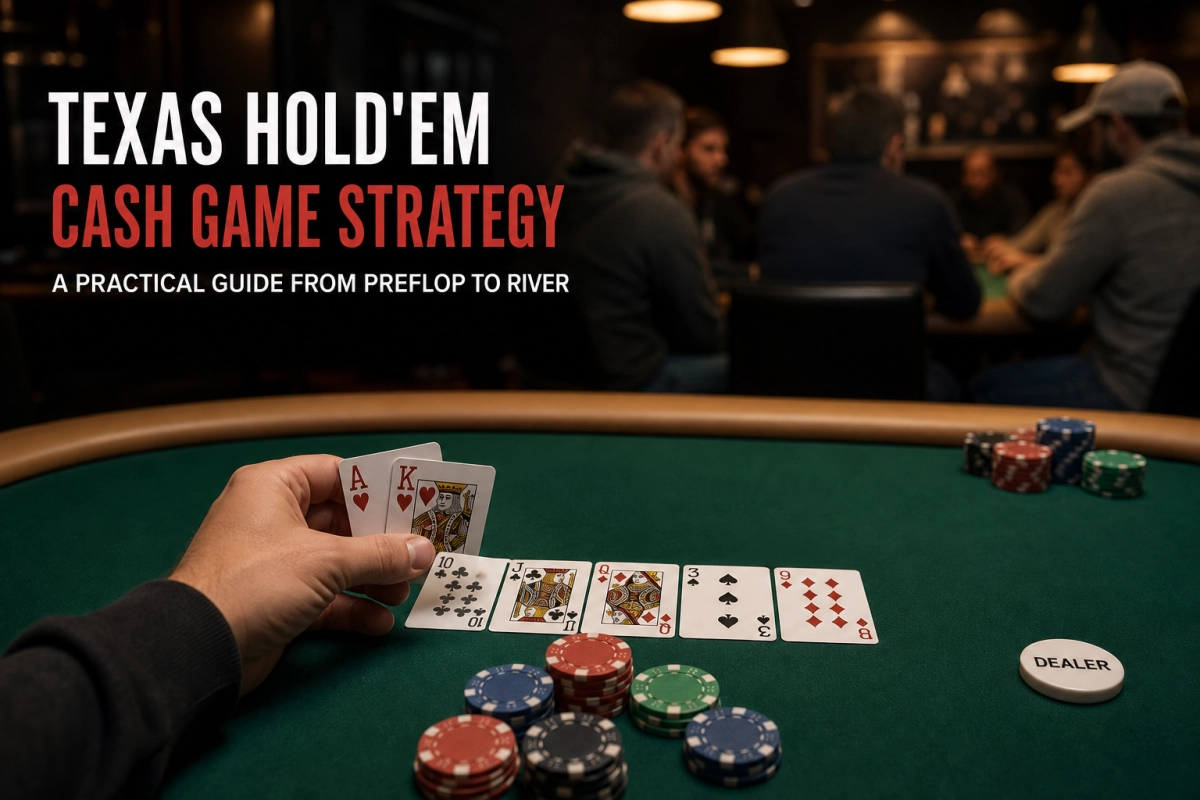
Why Cash Games Demand a Different Strategic Mindset
Cash games and tournaments share the same fundamental rules but reward very different habits. In a tournament, survival matters above all else. In a cash game, every decision has a direct monetary value and chips can be reloaded at any time. That distinction changes everything about how a player should approach each hand and each decision at the table.
Applying effective Texas Hold’em strategies in a cash game means thinking less about short-term chip preservation and more about long-term decision quality. A player who consistently makes sound choices — folding when odds are unfavorable, extracting value with strong hands, managing pot size intelligently — will outperform opponents who rely on instinct alone. The goal is not to win every pot but to make the most profitable decision available in each situation.
Preflop Hand Selection and the Role of Position
The two hole cards a player receives before any community cards set the foundation for every decision that follows. Selecting which hands to play and which to fold is one of the most impactful skills in cash game poker, and one of the most commonly mismanaged by beginners.
Strong preflop hands include high pocket pairs such as aces, kings, and queens, as well as premium suited connectors and Broadway cards like ace-king and ace-queen. These hands provide a statistical edge before a single community card is revealed. Weaker hands — low off-suit connectors, mismatched low cards, hands with limited improvement potential — are generally more profitable to fold, particularly from early position.
How Position Changes Starting Hand Value
Position is the most underestimated concept in preflop strategy. A player acting later in the betting round has access to information that earlier players do not — how many opponents entered the pot, whether anyone has raised, how much aggression is already present. That informational advantage is genuine and significant.
A hand like jack-ten suited may be worth playing from the button, where positional advantage is greatest. The same hand from under the gun carries considerably more risk, since acting first means no knowledge of how the table will respond. Experienced cash game players widen their starting hand range from late position and tighten it significantly from early position. Table dynamics, opponent tendencies, and stack sizes all influence the decision, but this principle applies across most cash game scenarios.
Reading the Flop: Board Texture and What It Tells You
Once three community cards land, the strategic landscape shifts completely. The texture of the board — how coordinated, connected, or dangerous it appears — should immediately shape how the hand is played from that point forward.
Board texture falls along a spectrum from dry to wet. A dry board like king of spades, seven of clubs, two of hearts offers few draws. A wet board like jack of clubs, ten of clubs, nine of diamonds is loaded with straight draws, flush draws, and combination possibilities. The same hand plays very differently against each, and recognizing that distinction quickly is a core cash game skill.
On a dry board, a strong made hand like top pair with a good kicker often has room to bet for value without excessive concern about draws completing. On a wet board, players with strong hands generally need to bet larger to make it expensive for opponents chasing draws. Allowing a free card on a coordinated board is one of the most common and costly mistakes at the cash game table.
Continuation Betting with Purpose
When a player raised preflop and bets again on the flop regardless of whether they connected, this is a continuation bet, or c-bet. It is a legitimate tool, but most effective when applied with genuine intention rather than as a reflex.
A well-timed c-bet on a dry board against a single opponent can win the pot outright frequently, because the preflop raiser’s range is perceived as strong. Against multiple opponents, or on a board that likely connected with calling ranges, blind continuation betting loses effectiveness and becomes expensive over time. Bet sizing also carries meaning: around half the pot signals strength while risking less, whereas a bet closer to three-quarters or the full pot is more appropriate when protecting a strong hand on a dangerous board.
Pot Odds, Implied Odds, and the Mathematics Behind Calling
One quality that separates disciplined cash game players from recreational ones is fluency with pot odds. The concept is straightforward: pot odds compare the size of the current pot to the cost of the call, helping determine whether calling is mathematically justified based on the likelihood of completing a winning hand.
If a player faces a bet of twenty dollars into a pot of sixty dollars, the total pot after calling would be one hundred dollars, and the call costs twenty — five-to-one odds. If the hand has better than a one-in-five chance of improving to the best hand, calling is profitable over time. If the odds are worse, folding is correct regardless of how much is already in the pot.
Implied odds extend this calculation by accounting for future betting streets. A player drawing to a flush might lack direct pot odds to call, but if completing that flush is likely to extract significant additional bets from an opponent with a strong second-best hand, the effective odds improve.
- Direct pot odds apply to the current cost of the call relative to the pot as it stands.
- Implied odds account for additional value reasonably extractable on later streets.
- Reverse implied odds — the risk of completing a draw only to lose to a better hand — are equally worth considering with vulnerable drawing hands.
A player who internalizes pot odds does not need precise calculations every hand. With practice, approximate ranges become intuitive, but the underlying logic should inform every significant call — especially in larger pots where mistakes carry real financial consequence.
Turn and River Play: Where Cash Game Edges Are Cemented
The flop reveals the broadest range of possibilities, but the turn and river is where cash game profits are most directly shaped. By the time a fourth community card appears, pot sizes have grown and decisions carry substantially more weight.
On the turn, a player with a strong made hand generally wants to continue building the pot. A well-sized bet of around half to two-thirds of the pot keeps pressure consistent and prevents opponents from realizing equity cheaply. Slowing down with a strong hand invites free cards and weakens the betting story a player has been telling. Conversely, a player on a draw must reassess on the turn — with one card remaining, the odds of completing a flush or straight draw drop meaningfully. When pot odds no longer support calling and implied odds cannot bridge the gap, the disciplined move is to release the hand.
The river is the street of commitment. With no more cards to come, every bet is either a value bet or a bluff. Strong players size river value bets to extract maximum payment from hands that will call but not raise, and bluff selectively in spots where their range is believable and opponents hold enough folding hands to make the attempt worthwhile. Bluffing the river out of frustration or habit simply transfers money to patient opponents.
Managing Pot Size as a Strategic Tool
Not every hand needs to become a large pot. Controlling pot size — keeping pots smaller with hands of uncertain strength, allowing them to grow with hands that perform better in larger confrontations — is one of the quieter skills in cash game play. A middle pair on a draw-heavy board benefits from a smaller pot and a clean showdown. Top set on the same board wants the pot as large as possible. Pot control typically involves checking back on a street where betting would commit more chips than the hand justifies, or calling rather than raising when a raise would bloat the pot unfavorably. It is not passive play — it is intentional sizing in service of a clearly reasoned goal.
Building the Habits That Make Cash Games Profitable Over Time
Strategy in Texas Hold’em cash games is not a fixed formula applied identically to every hand. It is a framework of interlocking principles — positional awareness, selective aggression, mathematical fluency, and board reading — that combine and adjust in response to conditions that are always slightly different from hand to hand.
What separates consistent winners from players who break even or lose is rarely a single dramatic insight. It is the accumulation of small, correct decisions made across hundreds of hands: the fold in early position that saves a buy-in, the well-sized river value bet that extracts one extra call, the disciplined laydown of a second-best hand on a board that tells an obvious story.
Cash game poker rewards patience and penalizes impulsiveness. It rewards players who treat chips as real money with real consequences, who think in terms of long-run expectation rather than individual hand outcomes, and who approach the table with structured thinking each session rather than relying on feel alone. The strategies covered here — from preflop hand selection to river bet sizing — are practical tools, and their value is realized through consistent, deliberate application at the table.
The fundamentals are learnable. The edge they provide is real. What remains is the straightforward work of putting them into practice.