


Why building a daily poker study routine accelerates your improvement
You probably know that practicing hands at the table is necessary, but practice without structure is slow and uneven. When you give your study time a predictable shape and track what you do, you turn vague effort into repeatable progress. A daily routine reduces decision friction (you no longer wonder what to study), exposes leaks quickly, and helps you prioritize the highest-leverage concepts.
Think of the routine as a compact training loop: set an objective, execute focused study, record results, and reflect briefly. Over days and weeks that loop compounds. This part of the article shows how to pick the right goals and create a minimal schedule you can actually keep, so that tracking becomes painless rather than another chore.
Decide what to measure: simple metrics that reveal real progress
Tracking doesn’t have to be complex. You want a handful of metrics that tell you whether your decisions are improving. Too many numbers will bury the signal. Focus on measurable, actionable items you can log after each session.
Core metrics to track daily
- Session length: Total time spent studying and playing. Consistency matters more than long, infrequent marathons.
- Hands reviewed: Number of hands you analyzed with logic, solver output, or coach feedback.
- Mistakes identified: Specific leak types (folding too often, ignoring blockers, bet sizing errors).
- Concepts practiced: Theoretical topics you worked on (ICM, ranges, multiway play).
- Confidence rating: A quick 1–5 self-score for how confident you felt making decisions that day.
Record these in a single line or row in a simple spreadsheet or note app. That allows fast comparisons across days and reveals trends when you look at weekly aggregates.
Design a compact daily schedule you can maintain
Your daily plan should fit into real life. Aim for 30–90 minutes on study days, split into short, focused blocks. Here’s a practical template you can adapt:
- 5–10 minute warm-up: Quick review of yesterday’s notes or a short range-building drill to get your mind in poker mode.
- 20–40 minute theory block: Work through one concept—watch a short video, read an article, or review solver lines.
- 20–40 minute hand review: Analyze 5–10 hands you played or found in a study pool. Apply the concept you just practiced.
- 5–10 minute wrap-up: Log metrics, write one actionable takeaway, and set a target for the next session.
Use calendar blocks or alarms to protect these windows. The key is repeatability: even a 30-minute session has more cumulative impact than an isolated several-hour cram.
With your metrics chosen and a compact schedule drafted, the next step is to set up a tracking sheet and weekly review process so you can spot trends and adjust your focus accordingly.
Build a minimal tracking sheet that tells a story
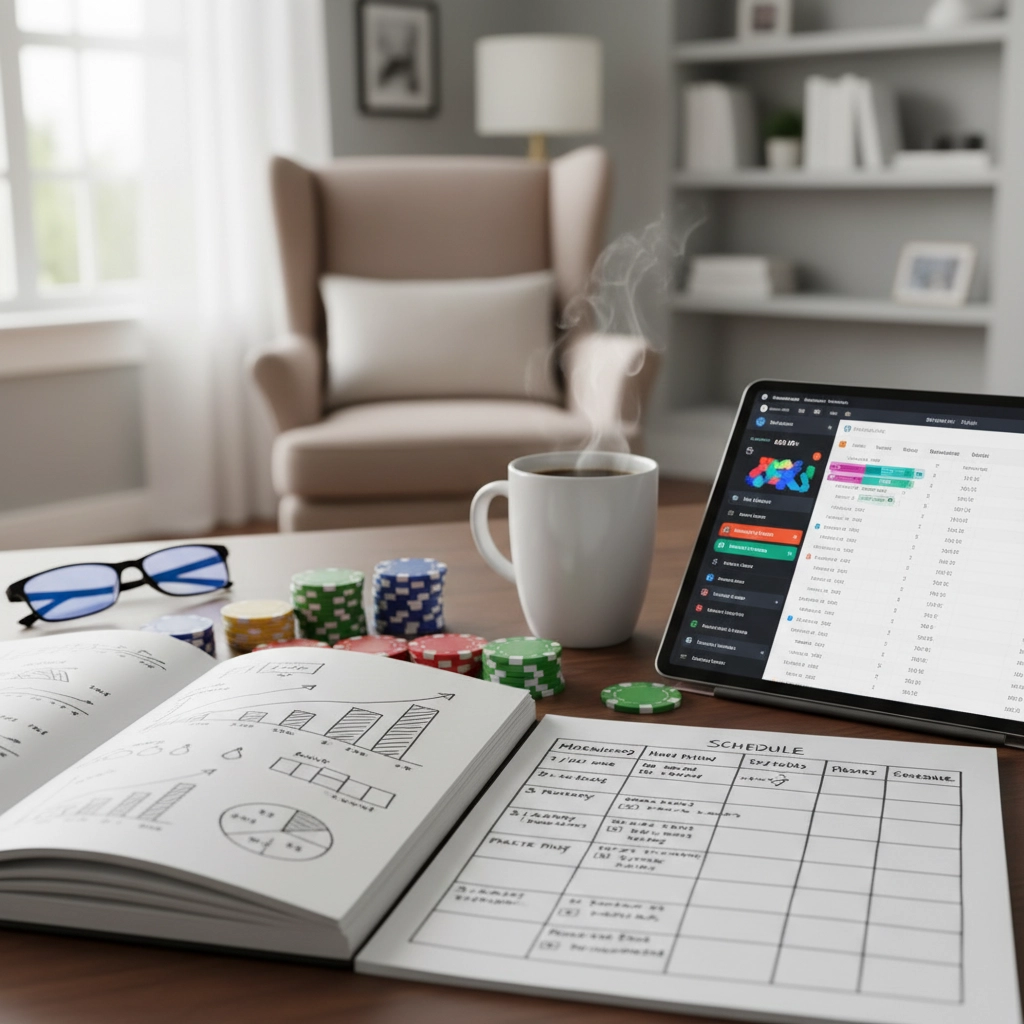
A useful tracker is less about bells and whistles and more about clarity. Set up a single-sheet layout that you can update in under a minute after each session. Keep columns simple and readable so patterns jump out when you scan a week.
Essential columns to include:
– Date and session length (minutes)
– Activity type (play / hand review / theory / mixed)
– Hands reviewed (count)
– Mistake types (comma-separated tags: fold bias, sizing, cold-call)
– Concept practiced (short tag: ranges, ICM, multiway)
– Confidence (1–5)
– One-line takeaway / action for next session
Add two small calculated fields: session total minutes (auto-sum) and a 7-day rolling average for confidence or hands reviewed. Conditional formatting helps: color rows where mistake tags appear more than twice, or shade low-confidence days red. This makes problem areas visually obvious.
If you use a spreadsheet, add a pivot or filter view to aggregate by concept or mistake type. Over a month you’ll be able to answer questions like: “How many hands did I analyze for three-bet pots?” or “Does my confidence grow after focused range work?” The point isn’t perfection — it’s a fast, reliable record that supports decisions in your weekly review.
Run a weekly review that drives precise adjustments
Make your weekly review a ritual: calendar it for the same time each week and keep it to 20–30 minutes. Use it to translate daily notes into focused next steps.
A simple weekly review flow:
1. Scan the week’s entries (2–3 minutes): note anomalies — long sessions with low confidence, repeating mistake tags.
2. Check rolling metrics (3–5 minutes): look at 7-day averages for confidence, hands reviewed, and mistake frequency.
3. Identify 1–2 priority leaks (5 minutes): pick the highest-leverage issues, not every annoyance. For example: “leak: folding too much to 3-bet” beats “improve bluffing” if the data shows a spike in fold errors.
4. Set one micro-goal for the coming week (5 minutes): a clear, measurable target — e.g., “Analyze 30 three-bet pot hands and apply solver ranges” or “Limit study to 45 minutes/day, focus on bet sizing choices.”
5. Schedule short experiments (3–5 minutes): decide how you’ll test the change and what success looks like.
Keep the review outcome actionable: assign the concept to a day, tag sessions in your tracker, and write a one-sentence hypothesis for each experiment.
Turn trends into small experiments and protect against burnout
Data without experiments is just noise. Use your tracker to design tiny tests: change one variable, collect a modest sample (e.g., 50 hands or one week), then compare results against the baseline. Example experiment structure:
– Hypothesis: “Using a polarized 3-bet sizing will reduce cold-call mistakes.”
– Intervention: “Practice solver lines and apply new sizing in hand reviews for 1 week.”
– Measurement: “Count cold-call mistakes and confidence in 3-bet pots before and after.”
Limit experiments to one or two at a time. If you try to overhaul strategy and stamina simultaneously you won’t know what worked.
Finally, protect your routine. If daily sessions feel like a grind, shorten the blocks, add an off-day, or swap in enjoyable study (hand builds, interesting pro hand breakdowns). Consistency matters more than intensity—small, sustainable improvements compound into big results.
Make the routine yours and keep it simple
Habits beat inspiration. Pick one compact schedule that fits your week, choose a handful of metrics you’ll actually log, and run a two-week micro-experiment. Adjust only one variable at a time and protect the routine by shortening sessions or swapping in enjoyable study when motivation dips. If you want ready-made drills, solver guides, or structured lesson plans, check reputable poker training sites—then adapt what you learn to the minimal schedule that works for your life. Small, consistent steps compound faster than occasional deep dives.
Frequently Asked Questions
How much time should I study each day?
Aim for 30–90 minutes on study days. If you’re short on time, a focused 20–30 minute session is still valuable. Consistency matters more than duration: regular short sessions produce better long-term improvement than rare, long marathons.
Which metrics are the most important to track first?
Start with three simple metrics: session length, hands reviewed, and a confidence rating (1–5). Add a fourth—mistake types—once logging is painless. These give actionable signals without overwhelming you.
What should I do if I start burning out or miss several sessions?
Shorten sessions, schedule deliberate off-days, or swap the type of study (e.g., watch pro breakdowns instead of heavy solver work). Treat missed days as data, not failure: restart with a 7-day manageable plan and one clear micro-goal to rebuild momentum.