


How a focused 30-day study routine transforms your poker results
You probably already know that consistent practice beats sporadic grinding. A structured 30-day study routine forces deliberate learning, helps you track progress, and turns insights into habits you can apply at the table. Over one month you can repair leaks in your game, reinforce winning strategies, and develop a sustainable study rhythm that fits your schedule.
This plan assumes you’ll study 5–10 hours per week in addition to any playtime. The key is daily consistency: short, high-quality sessions usually beat long, unfocused ones. You’ll learn how to set measurable goals, choose the right study materials, and split your time between theory, hand review, and mental-game work so every minute moves the needle.
Define clear, measurable objectives before you start
Before you open your solver or replay files, decide what you want to accomplish. Vague aims like “get better” don’t translate into action. Use specific, measurable, achievable, relevant, and time-bound (SMART) goals so you can evaluate progress at the end of each week.
- Example outcome goals: Reduce preflop calling frequency by 10% in 4-max games; increase your c-bet success rate by 8% in single-table tournaments.
- Example learning goals: Master 3 river betting/GTO spots; learn one new solver concept per week and apply it in hand reviews.
- Tracking method: Maintain a simple spreadsheet with weekly metrics: sessions completed, hands reviewed, key concepts learned, and leak fixes implemented.
Structure your weekly study blocks and daily checklist
Breaking study into repeatable blocks prevents overwhelm and ensures balanced improvement. Use three core weekly blocks: Theory & Concepts, Hand Review & Application, and Mental/Bankroll Management. Each day pick one primary block and one short secondary task to reinforce learning.
- Theory & Concepts (2 sessions/week): Read strategy articles, watch targeted videos, or work through solver outputs. Limit each session to 45–90 minutes and focus on one concept.
- Hand Review & Application (2–3 sessions/week): Review recent hands, tag recurring mistakes, and replay hands using software. Aim for 20–40 hands per session with focused notes.
- Mental Game & Bankroll (1 session/week): Practice tilt-control routines, session debriefs, and bankroll checks. Record emotional triggers and corrective actions.
Each daily checklist item should be actionable: e.g., “Analyze 25 hands focused on 3-bet pots” or “Spend 30 minutes on river vs. river bet sizing.” Keep sessions short, measured, and purposeful so you can maintain momentum across 30 days.
With objectives defined and a weekly block structure in place, you’re ready to build the day-by-day checklist and begin executing the first week of focused study—next, you’ll get the detailed 30-day schedule and daily checklist items to follow precisely.
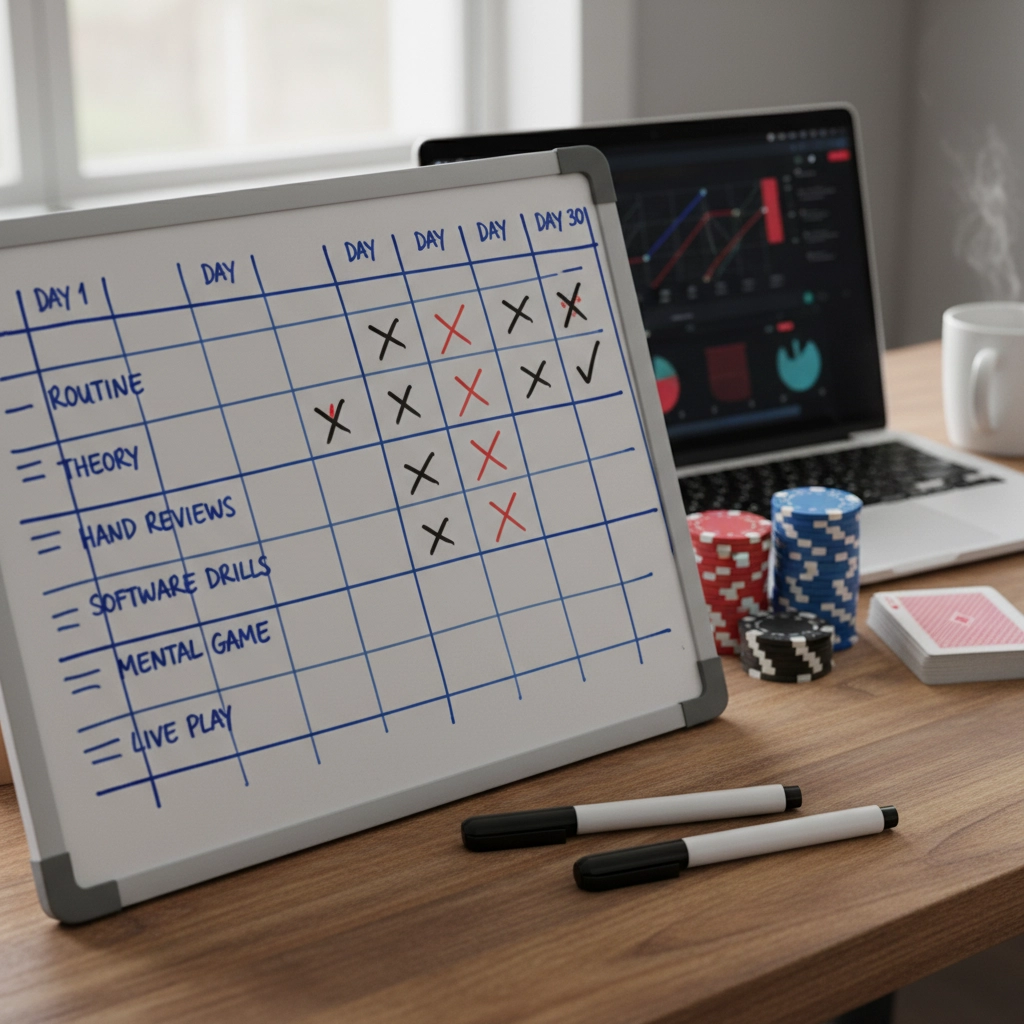
30-day calendar: week-by-week focus and a sample daily rhythm
Week the month so each block has a clear learning arc: Week 1 builds fundamentals, Week 2 drills postflop and exploitative lines, Week 3 expands multiway and tournament-specific skills, Week 4 polishes leaks and simulates peak performance. Below is a compact calendar you can copy into your spreadsheet.
– Week 1 — Fundamentals & preflop foundations
– Goal: Clean up preflop ranges, position discipline, and basic opening/3‑bet metrics.
– Weekly time: 5–8 hours (2 theory, 2 hand review, 1 mental)
– Week 2 — Postflop play & bet sizing
– Goal: Improve continuation-bet lines, check-raise spots, and sizing consistency.
– Weekly time: 6–9 hours (2 theory, 3 hand reviews, 1 mental)
– Week 3 — Multiway and tournament adjustments
– Goal: Play stronger multiway pots, bubble/endgame MTT decisions, ICM awareness.
– Weekly time: 6–10 hours (2–3 theory, 2–3 hand reviews, 1 mental)
– Week 4 — Leak fixing, simulation, and performance week
– Goal: Consolidate gains, address 1–2 biggest leaks, run simulated sessions under pressure.
– Weekly time: 6–10 hours (1 theory, 3 hand reviews, 2 simulation/mental)
Sample daily rhythm (repeatable, flexible)
– Monday (Theory): 60 minutes — read one article or watch a 45-minute video; extract 3 practical takeaways.
– Tuesday (Hand Review): 45–75 minutes — 25–40 hands tagged for a specific issue (e.g., c-bet success/failure).
– Wednesday (Short Application): 30–45 minutes — practice a solver spot or run a filter in your database.
– Thursday (Deep Review): 60–90 minutes — multi-street hands, size analysis, or tournament endgame spots.
– Friday (Mental/Bankroll): 30 minutes — session debrief, tilt triggers, bankroll check.
– Saturday (Play/Simulated Session): 60–120 minutes — focused play or timed solver drills.
– Sunday (Reflection & Planning): 30–45 minutes — weekly metrics update, plan next week’s focus.
Keep session goals explicit: e.g., “Analyze 30 3‑bet pots for flop textures” or “Run solver on 3 river spots and summarize 3 adjustments.”
Daily checklist templates: quick, focus, and deep sessions with examples
Use three checklist templates you can pick from depending on available time. Every checklist ends with a one-line action to apply at the table.
– Quick Session (20–40 minutes)
– Pick 1 micro-goal (preflop raise % or flop continuation frequency).
– Review 10–15 hands filtered for that goal.
– Note 2 recurring mistakes and 1 corrective action.
– Action: Apply corrective action next live session.
– Focus Session (45–75 minutes)
– Study 1 concept with resources (video/article/solver).
– Review 25–40 hands applying that concept; tag hands as “OK/Bad”.
– Write a short note: “When OOP vs BTN 3‑bet, size to X; fold Y.”
– Action: Implement new sizing or line in next 2 sessions.
– Deep Session (90–120 minutes)
– Run solver spots for 2–3 critical positions.
– Hand-by-hand review of 40–80 hands; create a short plan for each recurring leak.
– Mental check: identify tilt triggers seen this week and rehearse exact coping steps.
– Action: Simulate a pressured 60-minute session using the new adjustments.
Example day (Focus Session): “Tuesday – Analyze 30 c-bet failures on paired boards. Outcome: found excessive barrel frequency OOP; change: reduce turn barrel by 35% when missing equity. Next play: fold more turn bluffs vs calling stations.”

Weekly progress review: metrics, when to pivot, and how to prioritize new targets
Each Sunday review 5 metrics in your spreadsheet: sessions completed, hands reviewed, win rate or ROI (for tracked play), frequency metrics (open/3‑bet/c-bet), and one emotional metric (tilt incidents). Use these rules to adapt:
– If a targeted metric improves by ≥10% week-over-week, keep the theme but shift to the next skill.
– If no improvement after 2 weeks, narrow the focus: reduce the concept scope, add solver work, and increase hand count per session.
– If tilt or focus issues rise, temporarily reduce theory load and double down on short mental-game sessions.
Prioritize fixes by expected ROI: a correctable frequent leak (e.g., wrong 3‑bet calling frequency) beats a rare advanced line. Update your SMART goals each Sunday and set 3 micro-actions for the coming week.
Keep the momentum going
Commitment beats intensity once the novelty wears off. Treat the next 30 days as a habit-building experiment: journal what you do, hold yourself accountable to the checklist, and reward incremental wins. When progress stalls, narrow your focus, ask one clear question to solve next, and take a short break rather than forcing burned-out sessions.
If you want curated lessons or guided drills to supplement your routine, consider exploring dedicated training platforms like Runitonce training resources for structured modules and pro-led walkthroughs.
Finally, remember that study is a long game. Use this 30-day stretch to build repeatable systems — the habit of review, the discipline of targeted practice, and the resilience to adjust when results fluctuate — then iterate those systems into your ongoing routine.
Frequently Asked Questions
How many hours per week should I aim to study during this 30-day routine?
The plan in this article assumes roughly 5–10 hours per week of study in addition to play. Aim for consistent shorter sessions rather than sporadic long ones; adjust the weekly total to your schedule but keep daily consistency as the priority.
What should I do if I can’t stick to the daily checklist every day?
Prioritize consistency over perfection. If daily sessions aren’t possible, consolidate shorter sessions into a focused block a few times per week and use the weekly review to track progress. When gaps appear, simplify the checklist for that week and re-establish three small, non-negotiable actions.
How do I know when to pivot from one study focus to another?
Use measurable signals: if a targeted metric improves significantly, shift to the next skill; if there’s no progress after ~2 weeks, narrow the topic, increase hands or solver work, and repeat. Also factor in emotional metrics—if tilt or focus issues rise, temporarily prioritize mental-game work.