Why a structured training routine wins more tournaments
If you want to turn occasional deep runs into consistent tournament success, you need a repeatable routine. Poker tournaments reward discipline, pattern recognition, and the ability to adjust when dynamics change. A training routine made up of focused study, deliberate play, and rigorous review puts you in control of your improvement. You’ll stop relying on variance excuses and start creating edge through habits.
What a balanced routine looks like
Think of your routine as three interlocking pillars: study to expand understanding, play to apply concepts under pressure, and review to extract lessons. Each pillar has a clear purpose and a set of activities that fit into daily, weekly, and monthly cycles. When you treat them as equally important, you’ll build both knowledge and the mental resilience needed for late-stage tournament spots.
Create clear goals and schedule study blocks
Before you open any training software or start a session, define what success looks like this week or month. Are you targeting better bubble play, improving 3-bet shove decisions, or tightening up endgame ICM lines? Concrete goals keep your study efficient and prevent scattered learning.
Design practical study sessions
- Time-box your study: 45–90 minute blocks with a single focus avoid fatigue and increase retention.
- Mix theory with drills: combine solvers, hand history review, and short quizzes on ranges and bet sizing.
- Use active learning: explain lines aloud, create decision trees, or write short notes that summarize when to deviate from default plays.
- Rotate topics weekly: one week on preflop strategy, the next on postflop texture recognition, then on ICM and push/fold charts.
Plan play sessions that maximize learning value
Playing without an intent is wasted time. Define what you want to practice in each session—late-stage aggression, multi-table endurance, or short-stack strategy—and pick stakes and formats that let you practice those skills without unnecessary stress. Keep sessions to a sustainable length; longer isn’t always better if tilt or fatigue erode decision quality.
Structure your play for feedback
- Warm up with focus drills: review one hand-type or opening range before you start.
- Limit session variables: play fewer tables if you’re practicing complex reads or more tables when training multi-table management.
- Mark hands to review later: use in-client notes, tags, or a simple spreadsheet to flag hands that felt unclear or costly.
With clear goals, scheduled study blocks, and purposeful play, you create a feedback loop that accelerates learning. The next section will show how to conduct efficient hand reviews, use solver outputs effectively, and turn review findings into concrete changes in your game plan.
Conduct efficient hand reviews that actually teach
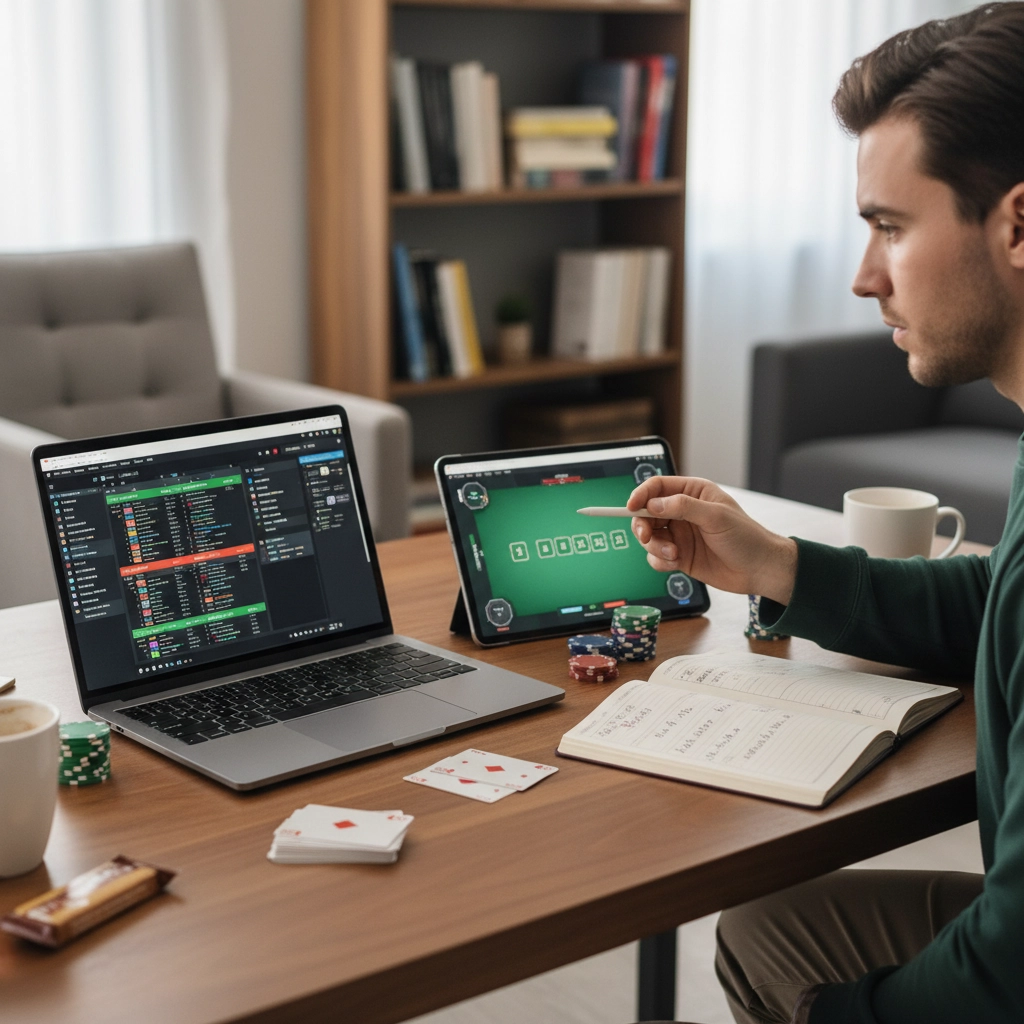
The value of a hand review isn’t how many hands you open—it’s what each review teaches and whether you change behavior afterward. Make reviews a focused, repeatable process so learning compounds.
– Time-box and prioritize: Spend 10–20 minutes on quick daily reviews (the hands you marked during play) and reserve one 60–90 minute block weekly for deep dives. Prioritize hands that repeatedly cost you chips, occurred in key spots (bubbles, final table), or expose a recurring leak.
– Use a consistent review template: For each hand note the context (tournament stage, effective stacks, ICM pressure), your objective (fold equity, protection, value), known opponent tendencies, and the range you assign to each player. Then answer: What was my default line, what are likely GTO alternatives, and what exploitative adjustments exist?
– Separate facts from feelings: Record the stack sizes, action history, and timing tells before you interpret. Emotions color recall—write down the objective line first, then add your reasoning and any tilt indicators.
– Rate the decision: Mark whether the line was clearly correct, borderline, or a mistake. For borderline hands, log the specific missing information (wrong range, equity misread, or bet-sizing miscalculation) so future study targets the gap.
– Build a searchable hand bank: Tag hands by theme (ICM shove, multiway float, bubble squeeze) and include solver + equity screenshots when useful. Over time you’ll spot patterns in mistakes and avoid re-teaching the same lesson.
Use solver outputs in a way that improves real-game decisions
Solvers give you a theoretical baseline but they’re only useful if translated into digestible, actionable rules you can apply at the table.
– Start with simplified trees: Model the spot with realistic stack depths, bet sizes, and a limited range of actions. Overcomplicating the tree makes it harder to extract practical rules.
– Look for robust patterns, not specifics: Pay attention to frequency trends (e.g., when the solver mixes fairly evenly between bet and check) and strategic principles (how ranges polarize on certain textures). These are transferable; exact bet sizes or combos are less so.
– Measure practical EV differences: Focus on when deviation from the solver costs meaningful EV. If a “mistake” loses only a tiny fraction of BBs, don’t force a complex adjustment that increases cognitive load.
– Translate outputs into heuristics: Convert solver recommendations into one-line prompts you can use in-game (e.g., “Against a short-stacked caller on dry boards, prefer larger c-bets for fold equity” or “Polarize 3-bet range when OOP and deep to protect equity”).
– Balance GTO with exploitative play: Use population tendencies and HUD stats to decide when to deviate. If a field over-folds to 3-bets, bias toward more bluffs; if calling stations overcall postflop, tighten value densities.
Turn review findings into a measurable improvement plan
Reviewing and solving is wasted unless changes are implemented and tracked. Create a closed-loop system that moves insights into practice.
– Create an action log: After each session, list 1–3 changes to test (e.g., adjust shove thresholds, change c-bet sizing on wet boards). Keep them simple and specific.
– Drill targeted skills: Use custom filters in play or practice labs to rehearse one adjustment (bubble shove decisions, multiway ICM, or short-stack versus big-stacks). Repeat the drill until the new line becomes automatic.
– Track metrics and thresholds: Monitor relevant KPIs—fold-to-3bet, showdown win rate, bubble ROI, or frequency of correct shove/fold decisions. Set sample-size thresholds before you judge the change.
– Review and iterate on a cadence: Daily quick fixes, weekly performance checks, and monthly meta-reviews help you separate noise from real improvement. If an adjustment isn’t producing measurable benefit after a reasonable sample, revisit the premise with new solver runs or opponent analysis.
By converting reviews and solver work into small, testable changes and tracking outcomes, you turn information into sustained tournament edge.

Putting the routine into motion
Start small and build momentum: pick one weekly theme, commit to a few focused study blocks, and schedule play sessions that purposefully test your changes. Treat the routine like physical training—consistency and progressive overload matter more than occasional intensity. Keep your action log current, enforce the review cadence, and give each tweak a fair sample before judging it.
Use trusted resources to accelerate learning, but keep the work practical: extract simple heuristics from theory, drill them until automatic, then re-check with solver work only when necessary. For additional guides and structured drills, see Upswing Poker.
Frequently Asked Questions
How should I split time between study, play, and review?
There’s no one-size-fits-all ratio, but a practical starting point is roughly 30–40% study, 50–60% play, and 10–20% review when measured weekly. Newer players should bias toward study; experienced players toward play and focused review. Use time-boxed blocks (45–90 minutes) and adjust based on which pillar is producing the most measurable gains.
How do I avoid overfitting solver outputs to amateur opponents?
Model simplified trees, look for robust patterns (frequencies, polarization), and convert outputs into easy-to-remember heuristics. Prioritize solver work for spots you encounter frequently or that cost significant EV. Cross-check solver recommendations against population tendencies and HUD data before adopting complex lines.
How long before I see real improvement in tournament results?
Improvements in specific skills (bubble play, shove thresholds) can show within weeks if drilled and applied; meaningful changes in ROI require larger samples and consistent practice—often several months. Track targeted KPIs (bubble ROI, fold-to-3bet, showdown win rate) and evaluate changes on predefined sample-size thresholds to separate variance from real progress.