

Make 30 Minutes Count: Why a Short Daily Poker Study Habit Works
You don’t need hours at a time to see real improvement. By studying poker for 30 focused minutes every day, you build consistency, retain concepts better, and make steady progress without burning out. Short, daily sessions leverage spaced repetition and allow you to immediately apply lessons at the felt, accelerating skill acquisition.
When you treat study like any other daily habit, you remove decision friction. Instead of waiting for “enough time,” you create a reliable opportunity to learn. Over weeks and months, those incremental gains compound—your range construction, bet sizing, and postflop reasoning will improve much faster than sporadic marathon sessions.
Identify Clear Learning Objectives Before You Open Tools
Before the timer starts, decide what you want to accomplish in that single session. A precise objective keeps you efficient and prevents shallow multitasking. Examples of effective 30-minute objectives include:
- Review 20 hands from last night’s session and note three exploitable tendencies.
- Study one preflop chart area (open-raising from BTN vs BB 3-bet) and summarize the rules.
- Work through three short GTO solver spots and extract one simplification rule.
- Practice mental game techniques for 10 minutes and journal tilt triggers for 20 minutes of reflection.
Simple, Reproducible 30-Minute Session Structure
Split your 30 minutes into focused blocks. The aim is to create a repeatable template you can use daily so learning becomes automatic. Below is a structure you can adapt to cash games, tournaments, or mixed play.
Sample 30-Minute Template
- Minute 0–2: Setup and focus. Close distractions, open only the tools you need (hand history viewer, solver, note app), and set a single objective.
- Minute 2–15: Active study. Dive into the core task—review hands, run solver spots, or read a focused chapter. Take short notes as you go; writing reinforces understanding.
- Minute 15–25: Practical extraction. Translate insights into simple rules or adjustments you’ll apply at the tables (e.g., “3-bet wider vs late-position steals”). Create a one-line action item you can remember.
- Minute 25–30: Quick log and next-step plan. Record what you learned, why it matters, and the specific drills for your next session. Set a measurable goal for tomorrow’s 30 minutes.
Tips to Maximize Short Sessions
- Use a timer and eliminate notifications—distractions kill effectiveness.
- Rotate topics weekly (ranges, exploitation, final-tablestudies, mental game) to keep learning balanced.
- Keep a persistent study journal so you can track trends and revisit past corrections.
With this foundation—clear objectives, a repeatable template, and focused tools—you’ll convert half-hours into meaningful improvement. In the next section, you’ll get sample daily routines tailored to cash games, MTTs, and sit‑and‑gos, plus concrete drills you can start tomorrow.
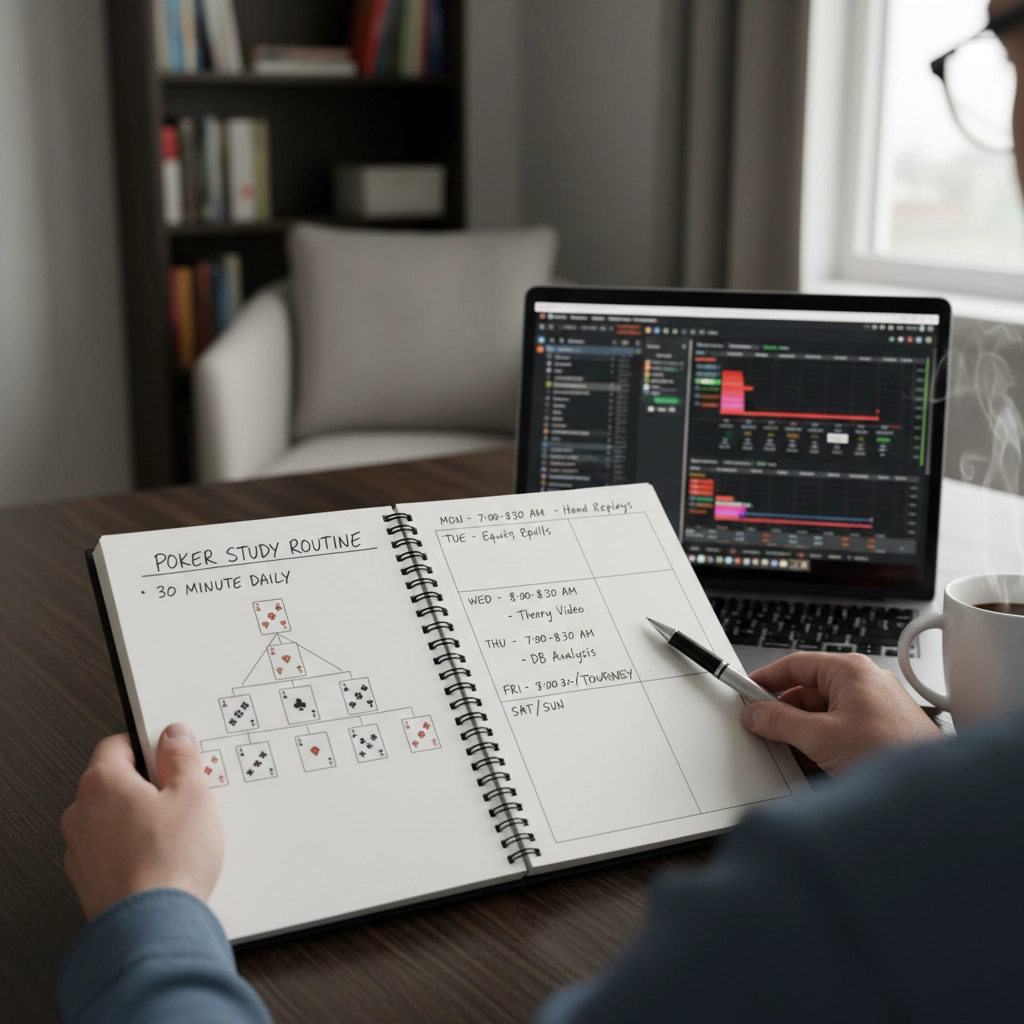
30-Minute Daily Routines for Cash Games, MTTs, and Sit‑and‑Gos
Different formats demand different study priorities. Below are three reproducible 30-minute routines you can rotate through depending on what you play that day. Each is built from the same template (setup → active study → extraction → log), but the focus shifts to the format-specific skills that move the needle.
Cash Game Session (30 minutes)
- Minute 0–2: Open hand-history viewer to the most recent two-hour session, set objective: “Fix cold 4‑bet response from BTN vs BB.”
- Minute 2–16: Review 8–12 hands flagged as marginal 4‑bet spots. Note opponent types and stack sizes. Run one representative spot in a solver for 5 minutes to compare your line.
- Minute 16–25: Extract one rule (e.g., “vs deep callers, tighten cold 4‑bet bluff frequency; prefer sizing +4‑bet to 40–45% pot”). Create a simple HUD note and a table reminder.
- Minute 25–30: Log the change, set tomorrow’s goal (practice 3-bet sizing adjustments), and record any immediate adjustments to HUD or preflop notes.
MTT Session (30 minutes)
- Minute 0–2: Choose target stage (early opening ranges, bubble play, or final-table ICM). Objective example: “Improve shove/fold decisions with 14–20bb.”
- Minute 2–15: Work through 4–6 shove/fold scenarios using an ICM calculator or solver. Focus on stack size, ante structure, and opponent tendencies.
- Minute 15–25: Convert solver outputs into simple shorthands (e.g., “15bb v BTN open: shove TT+ / fold 66–99 v tight folds”). Save these to a cheat-sheet you can quickly review pre-tourney.
- Minute 25–30: Journal mistakes from recent MTT runs and set a micro-goal (practice 10 shove/fold spots tomorrow).
Sit & Go Session (30 minutes)
- Minute 0–2: Target stage: bubble or heads-up. Objective: “Improve three-bet shove sizing in HU.”
- Minute 2–15: Replay 6–8 pivotal spots from hand histories or use a solver for HU shove/call ranges.
- Minute 15–25: Create a two-line rule and sample ranges for quick memory: “vs BTN shove: call with X; shove wider when SB is aggressive.”
- Minute 25–30: Note one live adjustment and set a follow-up drill.
High-Impact 30-Minute Drills to Build Core Skills
Here are repeatable micro-exercises to rotate through your sessions. Each drill is compact, measurable, and designed to be practiced daily.
- Hand-Variation Drill (10 min): Pick one hand you played poorly. Re-analyze it for 10 minutes with a solver or stronger player’s notes, then write a one-sentence correction.
- Range Visualization (7 min): Sketch or type the approximate range for common spots (open, 3‑bet, defend) without a solver—then compare to solver output for 3–4 minutes.
- Bet-Sizing Ladder (5–7 min): Create a table of three default sizings for common streets and justify each choice in one line (value vs protection vs fold equity).
- Mental Game Sprint (5–10 min): Short mindfulness/tilt checklist: breathe 2 min, list 3 tilt triggers, and plan one coping strategy for the next session.
- Exploit Finder (5–10 min): Scan recent hands for a single exploitable trend (over-folding to cbet, thin value extracting). Write the exploit and one tactic to use next time.
Monitor, Iterate, and Keep Your Routine Honest
Thirty minutes only works if you measure impact. Spend 1–3 sessions per week on meta-study: tracking, adjusting, and pruning your routine so it stays aligned with results.
- Track metrics: For cash—BB/100, WTSD, fold-to-3bet; for MTT—ROI, ITM%, final-table conversion. Record one change and check its effect over 2–4 weeks.
- Weekly audit (15–30 min once per week): Review your study journal, remove drills that stalled progress, increase time on leaks that cost chips, and adjust objectives for next week.
- Accountability: Share one weekly goal with a study partner or coach. External commitment increases adherence to the daily 30-minute habit.
Use these routines and drills as a living framework—rotate, refine, and keep the sessions tightly goal-oriented. Small, consistent practice plus measurement will compound into big improvements at the table.
Sustain the Momentum
Turning 30-minute study blocks into a long-term advantage is less about intensity and more about consistency. Pick a time, protect it like a table seat, and treat the session as non-negotiable. Use a simple trigger (same chair, same playlist, or a calendar alarm), a visible timer, and a one-line goal so you walk in with direction. Once the habit is established, use weekly audits and one accountability partner to keep your focus honest. For a practical read on building routines that stick, see this habit formation guide.
Frequently Asked Questions
How do I choose the most effective objective for a 30-minute session?
Make the objective specific and measurable: pick a single skill, spot, or set of hands (e.g., “fix BTN cold 4‑bet vs BB” or “practice 10 shove/fold spots at 15bb”). That keeps the session focused and makes extraction actionable.
How often should I rotate study topics (ranges, exploit, mental game)?
Rotate weekly or based on results. A good rhythm is to cycle core topics across the week and reserve 1–3 short sessions per week for meta-study (tracking metrics and auditing your routine) so you can prune or emphasize areas that actually move the needle.
Is 30 minutes daily really enough to improve in poker?
Yes—if the time is deliberate and consistent. Short sessions limit fatigue, encourage repetition, and force clarity. Combined with measurement, targeted drills, and live application at the tables, daily half-hours compound into meaningful improvement over weeks and months.